
Back Pain Statistics UK
Back pain is one of the most widespread and costly health problems in the United Kingdom. It is the leading cause of disability for both men and women in England, the single biggest driver of long-term sickness absence, and a condition that affects millions of people across every age group, occupation, and region.
Despite being so prevalent, back pain is frequently dismissed as an inevitable part of modern life. The data tells a different story. A significant proportion of back pain — particularly in the workplace — is preventable, and the cost of failing to prevent it is enormous: to individuals, to employers, and to the NHS.
This guide brings together the latest verified UK back pain statistics from the NHS, the Health and Safety Executive (HSE), the British Pain Society, and peer-reviewed research, covering prevalence, workplace causes, economic costs, and what the evidence says about prevention.
These figures are the latest available from official UK statistics, and this page is reviewed and updated as new data is published.
Key Facts & Figures (Overview)
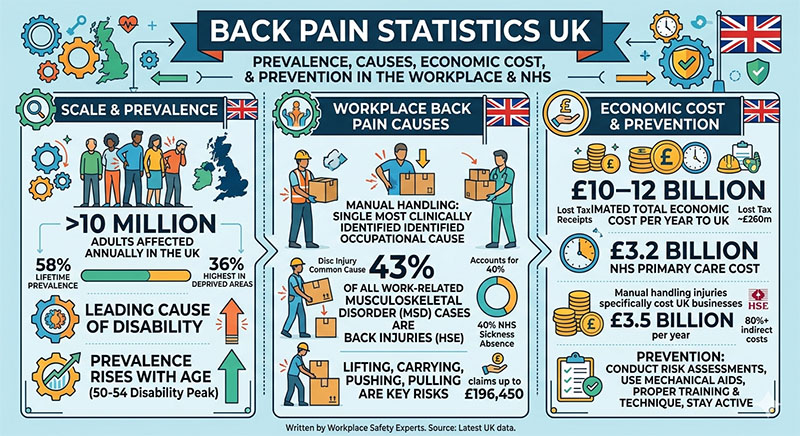
- Over 10 million adults in the UK are estimated to be affected by back pain annually, making it one of the most common reasons for GP consultations and long-term sickness absence.
- 26% of adults reported chronic pain in the Health Survey for England 2024, with back pain among the most frequently cited sites.
- Leading cause of disability in the UK — and the leading cause of years lived with disability globally since 1990.
- £3.2 billion per year is the estimated cost of back pain to the NHS in primary care costs alone, with the full economic burden substantially higher.
- £10–12 billion per year is the estimated total cost of back pain to the UK economy.
- 40% of sickness absence in the NHS is accounted for by back pain.
- 31 million working days are lost per year in the UK due to back, neck, and muscle pain combined.
- 43% of all work-related musculoskeletal disorder (MSD) cases in Great Britain are back injuries, according to HSE data.
- Manual handling — lifting, carrying, pushing, and pulling — is the single most clinically identified cause of work-related back conditions.
- Up to £196,450 can be reached by severe back injury compensation claims in the UK.
How Common Is Back Pain in the UK?
Back pain is one of the most universal health experiences in the UK. Research consistently shows that the majority of adults will experience back pain at some point in their lives, with a significant proportion developing recurring or long-term symptoms.
Key prevalence findings include:
- The lifetime prevalence of low back pain in Britain is estimated at around 58% — meaning more than half of adults will experience it at some point.
- The one-year period prevalence is approximately 36%, suggesting around a third of adults experience back pain in any given year.
- Back pain alone is estimated to affect over 10 million adults annually in the UK, making it one of the leading reasons people consult a GP.
- Low back pain is identified as the leading cause of morbidity for both men and women in England, accounting for three times the morbidity of the second most common condition, skin diseases.
- Prevalence varies geographically, with local authority rates ranging from around 11.8% to 21.4% across England.
Chronic Back Pain: The Scale of the Problem
While many people experience short-term episodes of back pain that resolve within weeks, a substantial proportion go on to develop chronic conditions that significantly affect their quality of life.
- The Health Survey for England 2024 found that 26% of adults reported chronic pain — defined as pain experienced most days or every day over the past three months — with musculoskeletal conditions, especially back and neck pain, accounting for the largest share.
- 13% of adults reported high impact chronic pain — pain severe enough to significantly limit daily activities.
- The British Pain Society estimates that 43% of UK adults (approximately 28 million people) live with some degree of chronic pain, of which musculoskeletal causes account for 60–65% of long-term cases.
- Approximately 8 million adults in the UK report chronic pain that is moderate to severely disabling.
- Chronic back pain is increasingly common among people in their 30s and 40s, driven by sedentary work, reduced physical activity, and poor posture — not just among older populations.
- Both the prevalence and severity of chronic back pain increased during and after the COVID-19 pandemic, linked to increased inactivity, worsened home working ergonomics, and reduced access to treatment.
Back Pain and Disability
The disabling impact of back pain is significant and well documented:
- Low back pain has been identified as the leading cause of years lived with disability globally since 1990, a position it has held consistently across three decades of Global Burden of Disease research.
- In the UK, back pain is the leading cause of disability particularly among working-age adults between 40 and 60 years old.
- Approximately 70% of all years lost to disability from low back pain fall within the working-age population (20–65 years).
- The disability burden associated with back pain has increased across all age groups between 1990 and 2019, with the greatest burden now seen in the 50–54 age group.
- 33% of all long-term sickness absence in England is attributable to musculoskeletal conditions, with back pain the largest single contributor within that category.
- 13% of UK adults report high impact chronic pain that limits their ability to carry out daily activities, work, or participate in social life.
Work-Related Back Pain
Back pain is not only a health problem — it is a major occupational hazard. A substantial proportion of all back pain cases in the UK have a direct work-related cause, and the burden falls particularly heavily on workers in physically demanding roles.
- Work activities contribute to back pain for around 19% of individuals who develop the condition.
- According to HSE data, back injuries account for 43% of all work-related MSD cases in Great Britain — the single largest category.
- Back-related conditions alone account for 41% of all MSD-related working days lost, disproportionate even to their share of cases, reflecting the severity and often recurring nature of these injuries.
- 511,000 workers in Great Britain were suffering from a work-related musculoskeletal disorder in 2024/25, a significant proportion of which involve back conditions.
- Work-related MSDs resulted in 7.1 million lost working days in 2024/25, with each affected worker losing an average of 14 working days.
- The healthcare costs of patients with back pain are estimated to be double those of matched controls without the condition, placing significant additional demand on NHS primary care services.
Manual Handling: The Leading Workplace Cause
For employers, the connection between manual handling and back injury is the most important and actionable insight in the back pain data.
- Manual handling — lifting, carrying, pushing, and pulling — is the single most clinically identified cause of work-related back conditions, according to medical reporting through the THOR-GP network, which assesses cases of occupational illness.
- The HSE’s Labour Force Survey confirms that manual handling, working in awkward or tiring positions, and repetitive actions are the three leading self-reported causes of work-related musculoskeletal disorders.
- Heavy lifting is specifically identified as the predominant factor in clinically assessed MSD cases — ahead of all other occupational risk factors.
- Manual handling tasks account for 17% of all non-fatal workplace injuries in Great Britain, making handling, lifting, and carrying the second most common cause of workplace injury overall.
- The most common cause of musculoskeletal back injuries from poor manual handling is disc injury — the result of concentrated stress at a single point on the spine when the back is bent under load.
- Back injuries are caused by working in awkward positions, repetitive movements, and carrying heavy loads — all of which are directly associated with poor manual handling practice or inadequate training.
- Severe back injury compensation claims can reach up to £196,450 in the UK, depending on the nature and permanence of the injury.
- Sectors with the highest rates of work-related MSDs — construction, agriculture, human health and social work, manufacturing, and retail and warehousing — are all characterised by high levels of manual handling activity.
Working Days Lost to Back Pain
The impact of back pain on UK productivity and workforce availability is enormous:
- An estimated 31 million working days are lost per year in the UK due to back, neck, and muscle pain combined.
- Lower back pain alone results in approximately 12 million lost workdays per year, making it the leading cause of working days lost among all musculoskeletal conditions.
- Work-related MSDs — of which back conditions are the largest component — caused 7.1 million lost working days in 2024/25 according to HSE figures.
- A full-time worker suffering from back pain is estimated to take an average of 13.3 days off per year, resulting in average earnings losses of approximately £1,468 based on mean salary figures.
- Back pain accounts for 40% of all sickness absence in the NHS — a striking figure given that the NHS is also one of the country’s largest employers, with a workforce of over 1.3 million.
- Musculoskeletal conditions overall account for a fifth of all sickness absence across the UK economy, resulting in the loss of around 28.2 million working days per year.
- The total working days lost figure does not capture presenteeism — the productivity lost when workers remain at work while in pain — which is estimated to be substantially higher than absence-based costs alone.
The Cost of Back Pain to the UK Economy
Back pain carries an enormous financial burden, borne by individuals, employers, the NHS, and the wider economy:
- The total economic cost of back pain to the UK is estimated at £10–12 billion per year, including NHS costs, lost productivity, disability payments, and informal care.
- Research published in the British Journal of Pain (2024) found that primary care costs alone attributable to back pain amount to £3.2 billion per year at a national level — and this figure excludes secondary care, inpatient treatment, outpatient appointments, and indirect productivity losses.
- Back pain costs the NHS an estimated £5 billion per year from GP appointments alone, according to analysis cited in The Lancet Rheumatology.
- Workers who take time off due to back pain generate lost tax receipts estimated at around £260 million per year for the Treasury.
- Over 80% of the total costs associated with low back pain in high-income countries are indirect costs — primarily lost productivity and disability payments — rather than direct healthcare costs.
- Manual handling injuries specifically cost UK businesses an estimated £3.5 billion per year in lost productivity, compensation, and healthcare costs.
- Compensation claims for serious back injuries can reach £196,450 for the most severe cases, with mid-range claims for significant but non-permanent injuries typically falling between £27,000 and £85,000.
Who Is Most Affected?
Back pain does not affect everyone equally. Several demographic and occupational factors are associated with significantly higher prevalence and severity:
- Age: Prevalence rises steeply with age. Chronic pain affects around 12% of those aged 16–24, rising to 40% of those aged 75 and over. The disability burden from back pain is greatest in the 50–54 age group. Workers aged 45 and above have significantly higher rates of work-related MSDs compared to the overall workforce.
- Gender: Women are more likely to report chronic pain (29%) than men (22%), and more likely to report high impact chronic pain (15% vs 11%). However, men in manual occupations show higher rates of occupational back pain, reflecting the physical demands of male-dominated industries such as construction and logistics.
- Deprivation: The prevalence of chronic pain is highest in the most deprived areas of England (36%) and lowest in the least deprived (19%) — a near twofold difference. Back pain is therefore also a social inequality issue, not merely a health one.
- Occupation: Workers in manual, physically intensive, and repetitive roles are disproportionately exposed. The highest rates of work-related MSDs are found in construction, agriculture, transport, health and social care, and warehousing — all sectors with significant manual handling demands.
- Workplace size: Workers in small workplaces experience statistically higher rates of work-related MSDs than those in larger organisations, likely reflecting fewer dedicated health and safety resources, less access to occupational health support, and lower rates of formal risk assessment.
Back Pain and Mental Health
The relationship between back pain and mental health is bidirectional and clinically significant:
- Chronic low back pain is associated with increased rates of depression, and depression is in turn linked to greater disability and worse recovery outcomes in people with back pain.
- The British Pain Society reports that severe chronic pain is associated with significantly increased risk of mental health conditions including anxiety and depression.
- People with high impact chronic pain are substantially more likely to have longstanding health conditions across multiple domains, compounding the complexity of their care needs.
- Back pain is among the leading drivers of work-related stress and reduced workplace wellbeing, particularly when workers feel they cannot take adequate time to recover or when inadequate support is available from employers.
- The psychological toll of chronic back pain — including fear of movement, loss of identity, reduced social participation, and financial stress from absence — is increasingly recognised as a central component of the condition’s impact, not a secondary one.
Back Pain Legislation and Employer Responsibilities
Employers in the UK have clear legal duties to protect workers from back injury. Key legislation includes:
- The Manual Handling Operations Regulations 1992 — require employers to avoid hazardous manual handling where reasonably practicable, assess unavoidable manual handling tasks, and take steps to reduce the risk of injury as far as reasonably practicable.
- The Health and Safety at Work etc. Act 1974 — places a general duty on employers to ensure the health, safety, and welfare of all employees, including protection from musculoskeletal injury.
- The Management of Health and Safety at Work Regulations 1999 — require employers to conduct suitable and sufficient risk assessments and implement appropriate controls.
- RIDDOR 2013 — requires employers to formally report back injuries and other workplace injuries that result in more than 7 days away from work.
- NICE Guidelines on Low Back Pain — while not legally binding, NICE guidance recommends exercise, manual therapy, and psychological support as the primary interventions for back pain, and forms the clinical standard against which treatment approaches are assessed.
Failure to comply with the Manual Handling Operations Regulations and related legislation can result in HSE investigation, enforcement action, and personal injury claims from affected workers.
Preventing Work-Related Back Pain: What Works
The evidence on back pain prevention in the workplace is clear: most work-related back injuries are preventable.
For Employers
- Carry out and regularly review manual handling risk assessments for all relevant tasks
- Eliminate or reduce manual handling where reasonably practicable through automation or mechanical aids
- Provide all workers with manual handling training appropriate to their role — not just a one-off induction
- Implement ergonomic improvements to workstations, storage layouts, and task design
- Encourage early reporting of discomfort — back pain is far easier to manage before it becomes chronic
- Offer access to occupational health support and, where possible, physiotherapy referral pathways
- Foster a workplace culture where taking back pain seriously is normalised, not stigmatised
For Workers
- Apply correct lifting technique at all times — bend the knees, keep the load close to the body, avoid twisting
- Use mechanical aids whenever available — trolleys, hoists, and pump trucks significantly reduce spinal load
- Break up repetitive or sustained postures with movement and regular rest
- Report back pain or discomfort early — do not wait until it becomes debilitating
- Engage with any manual handling training provided by your employer
- Stay active where possible — evidence consistently shows that remaining active, rather than resting, leads to better outcomes for most types of back pain
Written by Workplace Safety Experts
This guide was produced by the team at Manual Handling Training, a UK provider of RoSPA-approved and CPD-accredited online manual handling courses. Manual handling is the leading occupational cause of back injury in the UK, and our training is designed to help workers across all industries understand the risks, apply safe techniques, and protect their long-term health. Because this subject sits at the heart of what we do, we’re well placed to bring together the latest evidence and present it clearly for employers, HR professionals, safety officers, and workers alike.
Sources & references
- NHS England Digital – Health Survey for England 2024: Chronic Pain
- Health and Safety Executive (HSE) – Work-Related Musculoskeletal Disorders Statistics in Great Britain 2025
- Health and Safety Executive (HSE) – Health and Safety at Work: Summary Statistics for Great Britain 2025
- British Pain Society – UK Pain Messages 2024
- Zemedikun et al. (2024) – Healthcare Resource Utilisation and Economic Burden Attributable to Back Pain in Primary Care: A Matched Case-Control Study in the United Kingdom. British Journal of Pain
- The Lancet Rheumatology – The Global Epidemic of Low Back Pain (2023)
- UK Health Security Agency – The Economic Case for Preventing and Treating Musculoskeletal Conditions
- HSE – Manual Handling Operations Regulations 1992
- NICE – Low Back Pain and Sciatica in Over 16s: Assessment and Management
Related guides
Make sure your team is trained in safe manual handling.
Explore the Manual Handling Training Course →
Mark writes about workplace health & safety, manual handling and accredited online training for Manual Handling Training, part of Online CPD Academy.