
Cost of workplace injuries to UK businesses
Workplace injuries and work-related ill health impose one of the largest and most consistent financial burdens on UK employers, the public sector, and the individuals affected. The numbers involved are not marginal — they run into the tens of billions each year and affect businesses of every size, across every sector.
Yet the true cost of a workplace injury or illness is almost always greater than employers initially recognise. Visible costs — sick pay, insurance premiums, compensation claims — represent only part of the picture. Behind them sits a much larger body of uninsured, indirect costs: lost productivity, management time, the disruption of absence, reputational damage, and in cases of regulatory breach, investigation costs and potentially unlimited fines.
This guide brings together the latest verified data on the cost of workplace injuries and ill health to UK businesses, drawing on HSE economic analysis, enforcement statistics, and industry research — giving employers, HR professionals, insurers, and legal practitioners a clear and comprehensive picture of the financial stakes involved.
These figures are the latest available from official UK statistics, and this page is reviewed and updated as new data is published.
Key facts & figures (overview)
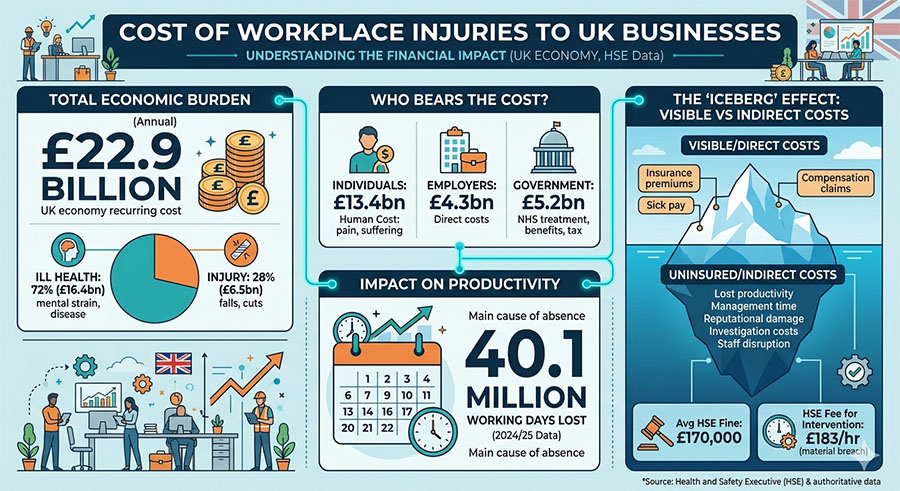
- £22.9 billion total estimated annual cost of workplace injuries and new cases of work-related ill health (2023/24 reference year) — one of the largest recurring costs in the UK economy.
- 72% of costs come from ill health (£16.4 billion); injury accounts for 28% (£6.5 billion).
- £13.4 billion borne by individuals — the largest share, driven primarily by human costs (pain, suffering, and loss of quality of life).
- £4.3 billion borne directly by employers.
- £5.2 billion borne by government through NHS treatment, benefit payments, and lost tax and National Insurance revenues.
- 40.1 million working days lost to workplace injury and work-related ill health in 2024/25 — an increase of approximately 19% on the previous year.
- Ten times — HSE estimate of uninsured losses from workplace incidents compared with insurance premiums paid.
- £315 per employee per year in uninsured losses from accidents in smaller firms.
- £170,000 average HSE prosecution fine in the 12 months from August 2024.
- £183 per hour — HSE Fee for Intervention rate (April 2025) for businesses found to be in material breach of health and safety law.
The £22.9 billion figure excludes long-latency illnesses such as occupational cancer — meaning the true total economic cost of past and current workplace exposures is substantially higher.
The £22.9 billion total: what it covers
The HSE’s headline cost figure of £22.9 billion is produced using a model that captures both financial costs and human costs arising from current working conditions:
Financial costs include:
- Net lost income and lost output from workers unable to work due to injury or illness
- Production costs such as recruitment, work reorganisation, and cover arrangements
- Healthcare costs including NHS treatment, rehabilitation, and medication
- Employer’s Liability Compulsory Insurance costs (net of compensation payouts)
- Administrative and legal costs associated with managing claims and regulatory compliance
Human costs include:
- A monetary valuation of pain, suffering, and loss of quality of life for injured or ill workers
- The value of life lost in the case of fatal workplace injuries
The model covers new cases of injury and illness arising from current working conditions — it does not include the ongoing costs of managing pre-existing conditions. It is therefore a conservative estimate of the current flow of harm being generated by UK workplaces, not the accumulated stock of workplace-related ill health and injury across the population.
The figure is calculated as a three-year rolling average, with the 2023/24 reference year representing the average of 2021/22, 2022/23, and 2023/24 data.
Who bears the cost?
The £22.9 billion total is not borne equally. The HSE’s distributional analysis reveals a clear pattern:
| Who pays | Cost | Share of total |
|---|---|---|
| Individuals | £13.4 billion | 58% |
| Government | £5.2 billion | 23% |
| Employers | £4.3 billion | 19% |
Individuals: £13.4 billion (58% of total)
The largest share falls on individuals and their families, driven primarily by human costs — the valuation of pain, suffering, and loss of quality of life. Workers who are injured or made ill also bear financial costs including lost earnings beyond sick pay entitlements, out-of-pocket healthcare expenditure, travel costs for treatment, and in serious cases, permanent reductions in earning capacity.
Government: £5.2 billion (23% of total)
The government bears substantial costs through NHS treatment and rehabilitation, administration of statutory sick pay, benefit payments to workers unable to return to employment, and the loss of income tax and National Insurance contributions from absent workers. This cost falls ultimately on the taxpayer.
Employers: £4.3 billion (19% of total)
Employers’ direct costs in the HSE model include sick pay, insurance premiums, production disruption, and recruitment and reorganisation costs. This figure represents the costs captured within the formal cost model — it does not fully reflect the broader indirect and uninsured costs that fall on businesses, which are discussed in the sections below.
The cost of ill health vs. the cost of injury
One of the most important distinctions in understanding workplace costs is between injury and illness:
- Work-related ill health — stress, depression, anxiety, musculoskeletal disorders, respiratory disease — accounts for 72% of total costs (£16.4 billion).
- Workplace injuries — physical accidents including slips, falls, manual handling, and machinery incidents — account for the remaining 28% (£6.5 billion).
Ill health generates disproportionately high costs because workers affected typically take longer off work than those with physical injuries. Conditions like work-related stress, chronic back pain, and respiratory disease often involve extended absences, multiple GP visits, specialist referrals, and in some cases, permanent incapacity or early retirement.
This distribution has important implications for how employers should prioritise their health and safety investment. Programmes focused solely on preventing physical accidents — while important — miss the larger portion of the cost burden. Mental health and musculoskeletal disorder prevention together offer the greatest potential for cost reduction.
Direct costs to employers
When a workplace injury or illness occurs, employers face an immediate set of visible, direct costs:
Sick pay — employers must pay at minimum Statutory Sick Pay (SSP) of £116.75 per week for up to 28 weeks. Many employers operate occupational sick pay schemes that pay full or partial salary for extended periods, substantially increasing this cost.
Employer’s Liability Insurance — all UK employers with one or more employees are legally required to hold Employers’ Liability Compulsory Insurance (ELCI) with a minimum cover of £5 million. Premiums are directly influenced by claims history — a poor safety record leads to higher premiums at renewal.
Compensation claims — workers injured at work through employer negligence can bring personal injury claims. Compensation for serious injuries — severe back injuries, loss of limb, permanent disability — can run to hundreds of thousands of pounds. Settlements for severe back injury can reach up to £196,450 in the UK.
Recruitment and replacement costs — when injured workers are absent, employers incur costs for temporary cover, overtime payments to existing staff, and in long-term absence cases, the recruitment and training of replacement employees.
Investigation and administration costs — any workplace injury triggers administrative obligations including RIDDOR reporting, incident investigation, and documentation. These costs grow substantially if the incident leads to regulatory investigation.
HSE investigation costs — where the HSE investigates a workplace incident and identifies a material breach of health and safety law, it charges under the Fee for Intervention scheme at £183 per hour (April 2025), covering all time spent investigating, taking statements, issuing notices, and following up. The average FFI invoice is approximately £875 and for enforcement notices, £1,500.
Indirect and hidden costs
Research consistently shows that the direct, insured costs of workplace incidents represent only a fraction of total business impact. The much larger component consists of indirect costs that are harder to attribute to any single incident but accumulate into a substantial drag on business performance:
Lost productivity — beyond the absent worker’s output, incidents affect the productivity of co-workers who respond to the emergency, managers who deal with the aftermath, and teams whose workflows are disrupted. Research suggests that witnesses to serious workplace accidents also experience reduced productivity through stress and lowered morale.
Management time — supervisors and HR professionals spend significant time investigating incidents, managing absences, liaising with occupational health, and dealing with regulatory correspondence. This time is rarely costed but is rarely negligible.
Reputational damage — serious workplace incidents become public through RIDDOR reporting, HSE enforcement notices, and in prosecution cases, court proceedings and press coverage. Reputational damage can affect contract awards, supply chain relationships, and the ability to attract talent.
Reduced team morale — employees who witness workplace injuries, who lose colleagues to absence, or who work in environments where risks are perceived as poorly managed report lower engagement, higher stress, and greater intention to leave.
Increased insurance premiums — a claims history generates premium increases at renewal. Multiple claims can result in the refusal of cover, forcing businesses to seek more expensive specialist insurers.
Damage to equipment and property — many incidents that injure workers also damage equipment, vehicles, or structures. Repair and replacement costs sit outside most direct injury cost estimates.
Lost contracts and procurement exclusions — in sectors including construction, public services, and supply chain logistics, serious safety incidents can trigger contract termination clauses, disqualification from procurement frameworks, or suspension of approved supplier status.
The iceberg principle: uninsured costs
The HSE’s established guidance on workplace incident costs uses the analogy of an iceberg to describe the relationship between insured and uninsured costs:
- The insured, visible costs above the waterline — compensation payouts, insurance premiums, sick pay — are the portion most employers focus on.
- The uninsured, hidden costs below the waterline — lost productivity, management time, reputational impact, equipment damage, morale effects — are typically far larger.
The HSE estimates that uninsured losses are approximately ten times the cost of insurance premiums paid. For smaller businesses, uninsured losses from accidents add up to an estimated £315 per employee per year — even before any serious incident occurs.
This ratio has profound implications for how employers should calculate the return on investment from safety programmes. A business that calculates only its insurance costs when evaluating health and safety spend is likely underestimating the total benefit of prevention by a factor of ten.
Working days lost: the productivity burden
The working days lost figures provide the most direct measure of the productivity impact on UK businesses:
- 40.1 million working days were lost to work-related illness and workplace injury in 2024/25 — equivalent to more than 200,000 full-time workers being absent for an entire year.
- This represents a 19% increase on the previous year — a dramatic acceleration that reflects both rising ill health and more severe conditions.
- 35.7 million of those days were lost to work-related ill health — stress, MSDs, respiratory conditions, and other occupational diseases.
- 4.4 million days were lost to non-fatal physical injuries.
- Stress, depression and anxiety alone accounted for 22.1 million lost days — up from 16.4 million the previous year, a 35% increase in a single year.
- Musculoskeletal disorders accounted for 7.1 million lost days.
The productivity cost of this absence — calculated at average daily earnings — represents a substantial direct financial loss to employers, on top of sick pay obligations and replacement costs. It does not capture the further cost of presenteeism — reduced productivity among workers who remain at work while unwell — which occupational health research suggests is comparable in scale to formal absence.
Cost by type of condition
Different categories of workplace health and safety failure carry different cost profiles:
Work-related stress, depression and anxiety is the most costly category by volume of lost days, generating 22.1 million lost working days and an estimated employer cost of £1,300 per affected employee per year in direct absence costs alone. Including presenteeism, turnover, and reduced engagement, poor mental health costs UK employers an estimated £45 billion per year across the workforce.
Musculoskeletal disorders — of which manual handling is the leading cause — cost UK businesses an estimated £3.5 billion per year in lost productivity, compensation, and healthcare costs, generating 7.1 million lost working days annually.
Back pain specifically costs the UK economy an estimated £10–12 billion per year when NHS treatment, productivity loss, and welfare costs are included. It accounts for 40% of all sickness absence in the NHS — one of the UK’s largest employers.
Slips, trips and falls cost UK employers approximately £512 million per year in lost production and direct costs, with the total societal cost estimated at around £800 million per year.
Occupational diseases — particularly those with long latency periods such as mesothelioma and occupational lung cancer caused by historical asbestos exposure — generate approximately 11,000 deaths per year linked to past exposures, with associated healthcare and compensation costs that extend well beyond the current working population.
Regulatory and legal costs
Beyond the direct cost of injury and illness, employers who fail to meet their health and safety obligations face an additional layer of financial exposure through regulatory enforcement:
HSE prosecution fines: The average prosecution fine in the 12 months from August 2024 stood at £170,000. In 2024, total prosecution fines levied reached approximately £39.75 million across all health and safety cases. The largest individual fines in 2025 included:
- Cambridgeshire County Council: £6 million plus £300,000 costs
- British Airways: £3.2 million following serious injuries to baggage handlers
- Industrial Chemicals Ltd: £2.5 million following a major acid leak
Under the Sentencing Guidelines, fines for large organisations (turnover above £50 million) can be substantially higher than for SMEs for equivalent breaches — reflecting the principle that penalties should be proportionate to financial capacity.
Fee for Intervention (FFI): The HSE’s cost-recovery scheme charges businesses £183 per hour (April 2025) when inspectors identify a material breach of health and safety law. This clock runs from the moment the breach is identified through to resolution. The average FFI invoice is approximately £875; enforcement notices generate average charges of £1,500. In 2024/25 the HSE recovered £4.5 million through FFI charges across 5,143 businesses.
Corporate Manslaughter: Under the Corporate Manslaughter and Corporate Homicide Act 2007, organisations can face prosecution where a gross failure in how their activities are managed or organised causes a person’s death. Penalties include unlimited fines and publicity orders requiring the organisation to publicise its conviction. Individual directors and managers can face personal prosecution for manslaughter.
Employers’ Liability claims: Workers injured through employer negligence have three years from the date of injury to bring a personal injury claim. The cost of defending and settling such claims — including legal fees, management time, and compensation — adds substantially to the total cost of incidents that involve employer fault.
The cost of non-compliance vs. the cost of prevention
One of the most compelling financial arguments for workplace health and safety investment is the comparison between the cost of compliance and the cost of enforcement action:
- Annual health and safety compliance costs for an SME average approximately £44,214 per year, based on HSE research adjusted for inflation.
- The average prosecution fine in 2020 was approximately £106,984.
- This means compliance costs an SME approximately £62,770 less than the average fine — before factoring in the costs of investigation, legal representation, increased insurance premiums, and reputational damage.
- For a small business with fewer than 50 staff, annual compliance costs fall to approximately £6,687 — compared to the same average fine of £106,984. The gap is even more striking: compliance costs £100,297 less than the average breach fine.
- These comparisons capture only the direct fine. Total costs of a serious prosecution — including legal fees, management time, settlement costs, remediation costs, and insurance premium increases — typically substantially exceed the fine itself.
The HSE has also increased its enforcement activity. In 2024/25 the HSE carried out over 13,200 workplace inspections, and has signalled a continued increase in inspection activity going forward, particularly targeting work-related ill health risks including stress and occupational health.
Long-term trends: are costs rising?
The long-term cost data shows a clear pattern of escalation following the pandemic:
- Prior to 2020, total cost estimates had remained broadly stable since approximately 2009/10, fluctuating within a relatively narrow band.
- Since the pandemic, costs have settled at a higher level, reflecting the sustained elevation of work-related ill health rates above pre-pandemic levels.
- The current estimate of £22.9 billion is broadly unchanged from the previous year in real terms, but remains substantially above pre-pandemic levels.
- Working days lost have increased by approximately 19% in a single year, driven primarily by the sharp rise in stress-related absence.
- If the upward trajectory in stress cases and associated lost days continues, total cost estimates are likely to increase in future years.
- The costs excluded from the headline figure — particularly long-latency occupational diseases — add further to the true total cost of workplace health and safety failures, and their full financial impact will continue to be felt for decades.
What these figures leave out
Understanding the scope of the £22.9 billion estimate requires an awareness of what it does not include:
- Long-latency illnesses such as occupational cancer are explicitly excluded. The estimated 13,000 annual deaths from occupational lung disease alone — and the associated NHS, welfare, and productivity costs — are not captured in the headline figure.
- Pre-existing cases of work-related ill health are excluded — only new cases arising from current working conditions are counted.
- Presenteeism — the productivity cost of workers remaining at work while unwell — is not fully reflected in cost estimates based on absence days. Research suggests presenteeism costs are comparable in scale to formal absence.
- Non-financial human costs — the impact on personal relationships, family life, mental health, and life satisfaction — cannot be fully monetised and are therefore captured only partially in the human cost valuation.
- Northern Ireland is not included — the HSE covers Great Britain only. Northern Ireland has its own separate regulatory framework under the Health and Safety Executive for Northern Ireland (HSENI).
The true total cost of workplace injury and ill health — including all categories of occupational disease, the full productivity cost of presenteeism, and all human impacts — substantially exceeds the headline figure.
Reducing workplace injury costs: the business case
The financial case for investing in workplace health and safety is clear and well evidenced:
- Every £1 invested in ergonomic workplace interventions is estimated to generate a return of approximately £17.80 through reduced absence, improved productivity, and lower compensation costs.
- Research indicates that stressed employees are up to 60% more likely to make errors and 50% less productive than their unstressed counterparts — meaning the productivity gain from effective stress management substantially exceeds the cost of intervention.
- For every £1 spent on safety, companies typically save between £2 and £6 in direct and indirect costs of workplace accidents.
- Compliance costs for an SME (~£44,214 per year) are consistently lower than the cost of a single prosecution fine (~£106,984 average) — before indirect costs are included.
- Insurance premiums are directly linked to claims history — a sustained improvement in safety performance generates compounding reductions in Employers’ Liability Insurance costs over time.
- Businesses that invest effectively in occupational health also benefit from reduced staff turnover, improved recruitment, and higher employee engagement — returns that extend well beyond the direct cost of safety compliance.
Written by workplace safety experts
This guide was produced by the team at Manual Handling Training, a UK provider of RoSPA-approved and CPD-accredited online health and safety training. Manual handling is among the most significant contributors to the UK’s workplace injury cost burden — responsible for approximately £3.5 billion in employer costs per year. We publish resources like this one because helping employers understand the true financial cost of workplace harm is one of the most effective ways of making the business case for the training and risk management that prevents it.
Sources & references
- Health and Safety Executive (HSE) – Costs to Great Britain of Workplace Injuries and New Cases of Work-Related Ill Health 2023/24
- HSE – Appraisal Values (Unit Costs) of Workplace Injuries and Ill Health
- HSE – Health and Safety at Work: Summary Statistics for Great Britain 2025
- HSE – Fee for Intervention
- RoSPA – The Cost of Accidents and Ill-Health at Work
- HSE – Reduce Risks — Cut Costs (INDG355)
- Sentencing Council – Health and Safety Offences, Corporate Manslaughter and Food Safety and Hygiene Offences Definitive Guideline
Related guides
Make sure your team is trained in safe manual handling.
Explore the Manual Handling Training Course →
Mark writes about workplace health & safety, manual handling and accredited online training for Manual Handling Training, part of Online CPD Academy.