
Manual handling injury statistics UK
Manual handling injuries remain one of the most persistent and costly challenges facing UK workplaces. Despite decades of regulation, training requirements, and awareness campaigns, handling, lifting, and carrying tasks continue to injure hundreds of thousands of workers every year — across industries as varied as construction, healthcare, warehousing, and retail.
This guide brings together the latest verified UK manual handling injury statistics from the Health and Safety Executive (HSE) and other authoritative sources, to help employers, safety professionals, and workers understand the scale of the problem and what can be done about it.
These figures are the latest available from official UK statistics, and this page is reviewed and updated as new data is published.
Key facts & figures (overview)
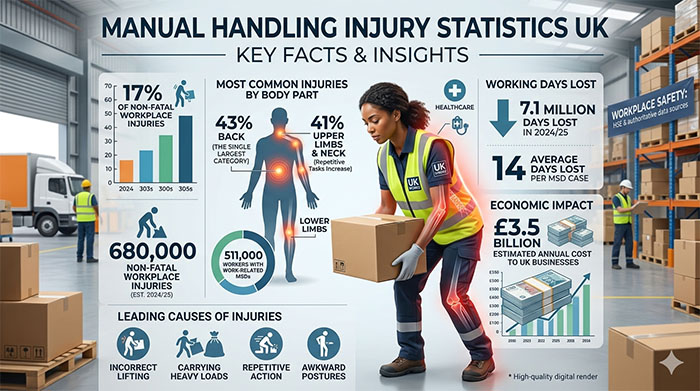
- 17% of all non-fatal workplace injuries in Great Britain are caused by manual handling tasks — the second most common cause of workplace injury.
- 680,000 workers are estimated to have sustained a non-fatal workplace injury in 2024/25.
- 511,000 workers are currently suffering from a work-related musculoskeletal disorder (MSD) — the primary health consequence of manual handling.
- 27% of all work-related ill health cases in Great Britain are MSDs.
- 7.1 million working days were lost in 2024/25 as a direct result of work-related MSDs.
- £22.9 billion is the estimated cost of all workplace injuries and new ill-health cases (2023/24 reference year).
- £3.5 billion per year is the estimated cost of manual handling injuries to UK businesses in lost productivity, compensation, and healthcare costs.
- 43% of all MSD cases are back injuries — the most common outcome.
How common are manual handling injuries?
Handling, lifting, and carrying is the second most common cause of non-fatal workplace injury in the UK, behind only slips, trips, and falls on the same level (30%). Manual handling has consistently accounted for 17% of all non-fatal workplace injuries, a figure that has remained unchanged between 2024 and 2025 according to the HSE’s latest release.
To put this in context, with an estimated 680,000 non-fatal workplace injuries occurring in 2024/25, manual handling tasks are responsible for roughly 115,000 injuries per year.
Which body parts are most affected?
Manual handling injuries do not affect the body evenly. HSE data consistently shows the following breakdown:
- Back: 43% of all work-related MSD cases — the single largest category
- Upper limbs and neck: 41% of cases (a figure that has been growing as repetitive tasks in warehousing and manufacturing increase)
- Lower limbs: The remaining proportion
Back-related conditions are particularly serious in terms of working time lost. Back injuries alone account for 41% of all MSD-related working days lost, despite making up 43% of cases — reflecting the severity and often recurring nature of these conditions.
Notably, new cases of upper limb and neck disorders increased between 2023/24 and 2024/25, signalling a shift that goes beyond traditional heavy-lifting hazards toward cumulative strain from repetitive tasks and poor workstation design.
Working days lost to manual handling injuries
The impact of manual handling injuries on UK productivity is significant:
- Work-related MSDs caused 7.1 million lost working days in 2024/25.
- Each affected worker loses an average of 14 working days per MSD case.
- MSDs account for 24% of all working days lost due to work-related ill health.
- Total working days lost across all workplace ill health and injury reached 40.1 million days in 2024/25 — an increase of approximately 19% over recent years.
These figures do not include the indirect costs to businesses from reduced output, temporary cover, retraining, and management time.
Which industries have the highest rates?
Manual handling injuries are not evenly distributed across the economy. Several sectors record significantly higher rates of work-related MSDs than the national average of 1,180 per 100,000 workers:
- Agriculture, forestry, and fishing — physically demanding and often seasonal, with high rates of lifting and carrying
- Construction — where 52% of musculoskeletal disorders are linked to manual handling tasks
- Human health and social work — with an estimated 68,000 work-related MSD cases, representing 22% of all ill health in the sector
- Manufacturing and production — repetitive assembly tasks and sustained awkward postures drive upper limb disorders
- Retail and warehousing — constant stock handling, reaching, and scanning creates cumulative strain
Within occupations, skilled construction trades, transport and mobile machine operatives, and elementary administration and service roles show particularly high rates.
Musculoskeletal disorders (MSDs) – the bigger picture
Musculoskeletal disorders are the primary health consequence of poor manual handling practices, and they represent one of the UK’s most significant occupational health challenges.
- In 2024/25, 511,000 workers were suffering from a work-related MSD (new or long-standing), down slightly from 543,000 the previous year.
- However, new cases of work-related MSDs increased, rising from 168,000 to 173,000 workers in the same period — a concerning signal that prevention efforts are not yet reaching new workers and new tasks.
- MSDs are the second-largest category of work-related ill health, behind stress, depression, and anxiety (52%).
- Prior to the COVID-19 pandemic, MSD rates had been on a gradual downward trend. That progress has now stalled.
- Workers aged 45 and above have significantly higher rates of work-related MSDs compared to the overall workforce.
- Workers in small workplaces also experience statistically higher MSD rates than average, suggesting that smaller employers face particular challenges in managing these risks.
The three leading self-reported causes of work-related MSDs are: manual handling, working in awkward or tiring positions, and repetitive action.
The cost of manual handling injuries to UK businesses
The financial case for investing in manual handling risk reduction is compelling:
- Manual handling injuries cost UK businesses an estimated £3.5 billion per year in lost productivity, compensation payments, and healthcare costs.
- Severe back injury compensation claims can reach up to £196,450 in the UK, depending on the nature and permanence of the injury.
- Workers injured by manual handling tasks typically take between 7 and 21 days off work, depending on the severity of the injury.
- The total cost of all workplace injuries and new ill-health cases across Great Britain stands at £22.9 billion (2023/24 figures).
- Employers also face indirect costs including management time, recruitment and retraining, reduced morale, and potential HSE enforcement action.
Manual handling injuries by cause
The most common contributing factors to manual handling injuries include:
- Lifting and lowering loads incorrectly — particularly bending at the back rather than the knees
- Carrying heavy or awkward loads over distances without mechanical assistance
- Repetitive handling tasks that cause cumulative strain rather than acute injury
- Working in awkward postures — twisting, reaching overhead, or working in confined spaces
- Pushing and pulling loads without appropriate equipment
- Lack of training — many injuries occur because workers have not been shown safe techniques or have not had a proper manual handling assessment
- Inadequate risk assessment — employers not identifying which tasks carry significant risk before injury occurs
Manual handling law in the UK
Employers in the UK have a legal duty to manage manual handling risks. Key legislation includes:
- The Manual Handling Operations Regulations 1992 (as amended) — require employers to avoid hazardous manual handling where reasonably practicable, assess the risk of any unavoidable manual handling, and reduce the risk of injury.
- The Health and Safety at Work etc. Act 1974 — places a general duty on employers to ensure the health, safety, and welfare of employees.
- The Management of Health and Safety at Work Regulations 1999 — require employers to carry out suitable and sufficient risk assessments.
- RIDDOR 2013 (Reporting of Injuries, Diseases and Dangerous Occurrences Regulations) — requires employers to report certain workplace injuries, including those resulting in more than 7 days away from work.
Failure to comply with these regulations can result in HSE investigation, enforcement notices, and prosecution.
Reducing manual handling injuries: what works
For employers
- Conduct regular manual handling risk assessments
- Eliminate unnecessary manual handling wherever possible
- Provide mechanical aids such as trolleys, hoists, and conveyors
- Ensure all workers receive appropriate manual handling training
- Monitor and review tasks that involve repetitive movements or heavy loads
- Create a culture where workers can report discomfort before it becomes an injury
For workers
- Use mechanical aids whenever they are available
- Apply correct lifting technique — bend the knees, keep the load close, avoid twisting
- Break up repetitive tasks with rest or rotation where possible
- Report pain or discomfort early — MSDs are much easier to treat before they become chronic
- Attend and engage with manual handling training
Written by workplace safety experts
This guide was produced by the team at Manual Handling Training, a UK provider of RoSPA-approved and CPD-accredited online manual handling courses.
Sources & references
- Health and Safety Executive (HSE) – Health and Safety at Work: Summary Statistics for Great Britain 2025
- HSE – Work-Related Musculoskeletal Disorders Statistics in Great Britain, 2025
- HSE – Manual Handling Operations Regulations 1992
- HSE – Costs to Great Britain of Workplace Injuries and New Cases of Work-Related Ill Health 2023/24
- NHS Employers – Musculoskeletal Health in the Workplace
Make sure your team is trained in safe manual handling.
Explore the Manual Handling Training Course →
Mark writes about workplace health & safety, manual handling and accredited online training for Manual Handling Training, part of Online CPD Academy.