
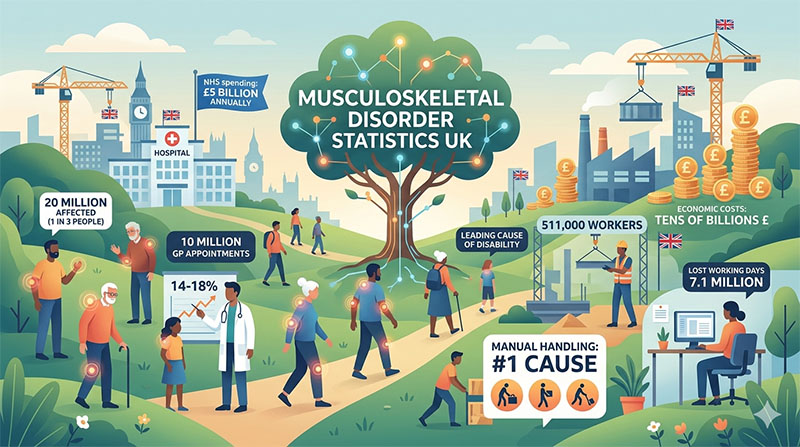
Musculoskeletal Disorder Statistics UK
Musculoskeletal disorders are the single biggest cause of pain and disability in the UK. They affect the muscles, bones, joints, tendons, ligaments, and nerves — encompassing conditions as varied as back pain, repetitive strain injury, osteoarthritis, tendinitis, and work-related upper limb disorders.
MSDs are not confined to older people or high-risk occupations. They affect more than 20 million people across the UK, account for one in five of all GP consultations, and represent the third largest area of NHS spending. In the workplace, they are the second largest category of work-related ill health after stress, responsible for hundreds of thousands of lost working days every year and billions of pounds in economic costs.
This guide brings together the latest verified UK MSD statistics from the Health and Safety Executive (HSE), NHS England, Versus Arthritis, the Office for Health Improvement and Disparities (OHID), and peer-reviewed research — covering prevalence, workplace causes, affected industries, costs, and what the evidence says about prevention.
These figures are the latest available from official UK statistics, and this page is reviewed and updated as new data is published.
Key Facts & Figures (Overview)
- 20 million people in the UK are affected by MSDs — approximately one in three of the total population.
- 10 million+ people in the UK have arthritis, one of the most common MSK conditions — that is one in six people.
- Leading cause of disability in the UK and the greatest cause of disability globally.
- 511,000 workers were suffering from a work-related MSD in 2024/25, representing 27% of all work-related ill health cases in Great Britain.
- 7.1 million lost working days from work-related MSDs in 2024/25, with each affected worker losing an average of 14 working days.
- £5 billion per year cost to the NHS — the third largest area of NHS spending, more than £13 million every day.
- 14–18% of all GP appointments in England relate to MSK conditions, with around 20% of the population consulting their GP about an MSK problem every year.
- 33% of all long-term sickness absence in England is due to MSDs.
- Tens of billions of pounds is the total annual cost of MSDs to the UK economy, including NHS costs, lost productivity, and disability payments.
- Manual handling — lifting, carrying, pushing, and pulling — is the single most clinically identified cause of work-related MSDs.
How Many People Have an MSD in the UK?
The scale of MSDs as a public health challenge in the UK is enormous:
- Research from Versus Arthritis estimates that over 20 million people in the UK — roughly one in three of the population — live with a musculoskeletal condition.
- Over 10 million people have arthritis specifically, making it the most prevalent MSK condition.
- Arthritis and related MSK conditions are described by the NHS as the single biggest cause of pain and disability in England.
- 13.4% of adults in England reported a long-term MSK problem alongside at least one other long-term health condition in 2024, underlining how frequently MSDs occur alongside other serious health issues.
- MSK conditions disproportionately affect people in deprived areas, with both higher prevalence and worse clinical outcomes for those living in the most disadvantaged communities.
- Around 20% of the population visits their GP each year about an MSK problem — making MSDs one of the most common reasons for primary care consultations in the UK.
- The true prevalence of MSDs is likely underestimated in official figures because many cases are not formally coded in clinical records or are managed without ever reaching a healthcare professional.
Work-Related MSDs: The Scale of the Problem
Within the workplace, MSDs represent one of the most significant and persistent occupational health challenges facing UK employers:
- In 2024/25, an estimated 511,000 workers suffered from a work-related MSD, encompassing both new and long-standing conditions — a prevalence rate of 1,470 cases per 100,000 workers.
- This figure, while slightly lower than the 543,000 recorded the previous year, remains above the five-year average of 501,000, indicating an underlying upward trend rather than sustained improvement.
- New cases of work-related MSDs actually increased from 168,000 to 173,000 workers between 2023/24 and 2024/25, a significant warning sign that prevention efforts are not keeping pace with emerging risks.
- Work-related MSDs account for 27% of all work-related ill health cases in Great Britain — the second largest category behind stress, depression, and anxiety (52%).
- 52% of musculoskeletal disorders in construction are directly linked to manual handling tasks, according to HSE data.
- Prior to the COVID-19 pandemic, rates of self-reported work-related MSDs had been on a gradual downward trend. That progress has now stalled, with rates broadly flat and new cases rising.
- In terms of current employees, approximately one in ten of the UK workforce has an MSK condition that may affect their work.
Which Body Parts Are Most Affected?
Work-related MSDs affect different parts of the body depending on the nature of the work involved. HSE data shows a near-even split between back and upper body injuries:
- Back injuries: 43% of all work-related MSD cases — the single largest category, affecting an estimated 221,000 workers. Back conditions alone account for 41% of all MSD-related working days lost, reflecting their severity and tendency to recur.
- Upper limbs and neck: 41% of cases — and this proportion is growing. New cases of upper limb and neck disorders increased between 2023/24 and 2024/25, driven by repetitive tasks, sustained postures, and poorly designed workstations in warehousing, manufacturing, and office environments.
- Lower limbs: account for the remaining proportion, with particular prevalence in roles involving prolonged standing, kneeling, or squatting.
The increase in upper limb and neck conditions represents a shift in the nature of MSD risk — away from traditional heavy-lifting scenarios and towards cumulative strain from repetitive tasks, DSE use, and hybrid working arrangements with substandard home office setups.
Working Days Lost to MSDs
The productivity impact of MSDs on the UK economy is substantial and growing:
- Work-related MSDs caused 7.1 million lost working days in 2024/25 — down from 7.8 million the previous year, but still representing an enormous burden on UK businesses.
- Each worker affected by a work-related MSD loses an average of 14 working days per case.
- MSDs account for 24% of all working days lost due to work-related ill health across Great Britain.
- 33% of all long-term sickness absence in England is attributable to MSK conditions — making them the single largest driver of long-term absence.
- Across the broader economy — including both work-related and non-work-related MSK conditions — an estimated 24–30 million working days are lost per year due to MSDs.
- Back pain alone accounts for 40% of all sickness absence in the NHS, one of the country’s largest employers.
- 12% of all NHS sickness absence between 2021 and 2022 was due to back problems and other MSK conditions.
- These figures do not capture presenteeism — reduced productivity among workers who remain at work while in pain — which is estimated to substantially exceed the cost of absence alone.
Which Industries and Occupations Are Most at Risk?
MSD risk is significantly higher in certain sectors and occupations. HSE data identifies the following industries as having statistically higher rates of work-related MSDs than the national average of 1,180 per 100,000 workers:
- Agriculture, forestry and fishing — physically demanding seasonal work with high rates of lifting, carrying, and exposure to whole-body vibration
- Construction — where 52% of work-related MSDs are linked to manual handling, and skilled trades workers face the highest rates
- Human health and social work — with an estimated 68,000 work-related MSD cases, representing 22% of all ill health in the sector; patient handling is a major risk factor
- Transportation and storage — long-distance driving, loading, and manual cargo handling all contribute significantly
- Manufacturing and production — repetitive assembly tasks, sustained overhead work, and awkward postures drive upper limb disorders in particular
- Retail and warehousing — constant scanning, reaching, and stock handling creates cumulative upper limb and shoulder strain
Within occupational groups, skilled construction trades, transport and mobile machine operatives, and elementary administration and service roles show particularly high rates — highlighting that both physically intensive and lower-skilled roles remain disproportionately exposed.
The Causes of Work-Related MSDs
Work-related MSDs rarely result from a single incident. Most develop gradually through cumulative exposure to risk factors that damage muscles, tendons, joints, and spinal structures over time.
The HSE identifies the following as key causes of work-related MSDs:
- Manual handling — lifting, lowering, carrying, pushing, and pulling loads without adequate controls or training. Heavy lifting is the leading clinically assessed cause of work-related MSDs according to the THOR-GP medical reporting network.
- Awkward or sustained postures — working bent, twisted, with arms raised, or in confined spaces places disproportionate stress on the spine and joints.
- Repetitive movements — tasks involving the same motion hundreds or thousands of times per shift cause cumulative strain, particularly to upper limbs, shoulders, and the neck.
- Use of vibrating tools — hand-arm vibration from power tools causes hand-arm vibration syndrome (HAVS) and contributes to upper limb disorders; whole-body vibration from driving affects the spine.
- Display screen equipment (DSE) use — prolonged computer use with poorly designed workstations contributes to neck, shoulder, and upper limb conditions, particularly where home working arrangements are ergonomically inadequate.
- Repetitive keyboard and mouse work — a growing cause of upper limb disorders, particularly in administrative and hybrid-working roles.
- Contact stress — pressure on soft tissues from resting against hard surfaces or edges.
- Work pace and recovery time — insufficient rest between repetitive tasks prevents tissue recovery and accelerates cumulative damage.
The Cost of MSDs to the UK Economy and NHS
The economic burden of MSDs in the UK is substantial at every level — to the NHS, to employers, and to the wider economy:
- MSDs are the third largest area of NHS spending, costing around £5 billion per year — equivalent to more than £13 million every day.
- MSK conditions account for 14–18% of all GP appointments in England, placing enormous demand on primary care services.
- The cost of working days lost due to osteoarthritis and rheumatoid arthritis alone — just two of the many MSD types — was estimated at £2.58 billion in 2017, with that figure projected to rise to £3.43 billion by 2030.
- Manual handling injuries specifically cost UK businesses an estimated £3.5 billion per year in lost productivity, compensation payments, and healthcare costs.
- The total cost of all workplace injuries and new cases of work-related ill health across Great Britain stands at £22.9 billion per year, with MSDs contributing a substantial share of that total.
- People with arthritis are 20% less likely to be in employment than people without the condition, representing a significant loss of productive economic capacity.
- For individuals, a career-ending MSD can result in a lifetime financial burden encompassing lost earnings, reduced pension contributions, and ongoing private treatment costs.
- Compensation claims for serious workplace MSDs — particularly back injuries — can reach up to £196,450 in the most severe cases.
- The NHS is facing record waiting lists for MSK treatment, with over 1 million people waiting for trauma or orthopaedic treatment, compounding the long-term economic impact of delayed diagnosis and intervention.
MSDs and Employment
The relationship between MSDs and employment is one of the most significant — and underappreciated — dimensions of the MSD challenge:
- The employment rate for people with an MSK condition classified as disabled was 57.5% in 2022–23, compared to 75.7% for the general population — a gap of 18 percentage points.
- Only around 59% of working-age people with an MSK condition are in employment.
- MSK conditions affect one in five of those classified as economically inactive in the UK — meaning they are neither in work nor seeking work, often because their condition prevents it.
- Over 2.8 million people are now outside the workforce due to long-term sickness, with MSK conditions identified as a primary driver by the Office for National Statistics (ONS).
- The Darzi review of NHS performance identifies MSK conditions as one of the primary causes of work absence due to ill health in the UK.
- Nearly 40% of workers with an MSK condition reported that the condition had caused them to change their work plans, with many moving to reduced hours, different roles, or early retirement.
- People with arthritis are 20% less likely to be in work than those without, and for current employees, around one in ten has an MSK condition that may affect their working capacity.
- Children and young people are not immune — under-16s diagnosed with juvenile idiopathic arthritis enter the labour market already carrying a significant MSK condition.
MSDs and Mental Health
The connection between MSDs and mental health is consistent, clinically significant, and bidirectional:
- Adults with a long-term MSK condition are 1.5 times more likely to also report a mental health condition than adults without an MSK condition, according to 2024 OHID data.
- This relationship is particularly strong among younger adults aged 16–24, for whom the odds ratio of having a mental health condition alongside an MSK condition reaches 3.8 — compared to 1.2 for those aged 85 and over.
- This striking figure among younger adults likely reflects the particular impact of developing a chronic pain condition during formative working and social years, when the psychological consequences of limitation and uncertainty are most acute.
- Chronic pain — the common experience of most MSD sufferers — is strongly associated with depression, anxiety, and social isolation.
- The pain and functional limitations of MSDs make it harder to manage other long-term conditions, compounding mental health impacts in those with multiple conditions.
- Over half of people (57%) living with arthritis report experiencing pain every single day, a level of chronicity that inevitably affects psychological wellbeing.
- MSDs are also a significant driver of work-related stress, particularly when workers feel unsupported, fear job loss, or are unable to access treatment quickly enough through NHS waiting lists.
- In the most deprived areas, the gap between the prevalence of mental health conditions in people with and without MSK conditions is widest — meaning inequality compounds in both directions.
Long-Term Trends: Has Progress Stalled?
The long-term trajectory of MSD rates in the UK shows a mixed picture:
- Before the COVID-19 pandemic, rates of self-reported work-related MSDs had been on a gradual downward trend, reflecting the impact of improved workplace ergonomics, manual handling training, and risk assessment.
- Since the pandemic, that progress has stalled. Current rates are broadly similar to pre-pandemic 2018/19 levels and show no signs of further improvement.
- More concerning, new cases of work-related MSDs increased from 168,000 to 173,000 workers in 2024/25 — despite total cases falling slightly, suggesting that while existing conditions are resolving, new ones are being created at a faster rate.
- The five-year average of 501,000 workers affected per year is trending upward, not downward.
- Working days lost to MSDs fell from 7.8 million to 7.1 million in 2024/25, but remain substantially above pre-pandemic levels.
- The broader population prevalence of MSK conditions is projected to increase as the population ages, obesity rates rise, and physical inactivity remains widespread — all of which are established risk factors for MSDs.
MSD Law and Employer Responsibilities in the UK
Employers in the UK have a comprehensive set of legal obligations to protect workers from musculoskeletal disorders. Key legislation includes:
- The Manual Handling Operations Regulations 1992 — require employers to avoid hazardous manual handling where reasonably practicable, assess any unavoidable tasks, and reduce the risk of injury.
- The Health and Safety at Work etc. Act 1974 — the foundational duty on employers to ensure the health, safety, and welfare of all employees, including protection from MSD risk.
- The Management of Health and Safety at Work Regulations 1999 — require employers to carry out suitable and sufficient risk assessments and implement appropriate controls.
- The Control of Vibration at Work Regulations 2005 — set legal limits on exposure to hand-arm vibration and whole-body vibration, both of which contribute to MSD development.
- The Health and Safety (Display Screen Equipment) Regulations 1992 — require employers to assess DSE workstations and reduce risks from prolonged screen-based work.
- RIDDOR 2013 — requires formal reporting of workplace injuries and occupational diseases, including specified MSD conditions, to the HSE.
Failure to comply with these duties can result in HSE investigation, enforcement notices, prohibition orders, and personal injury claims from affected workers.
Reducing Work-Related MSDs: What Works
The evidence base for MSD prevention in the workplace is clear: most work-related MSDs are preventable, and early intervention dramatically improves outcomes.
For Employers
- Conduct thorough manual handling risk assessments for all tasks involving lifting, carrying, pushing, or pulling
- Redesign tasks and workstations to eliminate or reduce the need for hazardous manual handling
- Provide mechanical aids — trolleys, hoists, pump trucks, conveyor systems — and ensure workers actually use them
- Ensure all workers receive role-appropriate manual handling training, updated regularly
- Carry out DSE assessments for all screen-based workers, including those working from home
- Implement job rotation to reduce repetitive strain on specific muscle groups
- Create a culture where workers can report early symptoms of discomfort without fear — early intervention prevents acute injuries from becoming chronic conditions
- Provide access to occupational health support and, where possible, physiotherapy referral pathways
For Workers
- Report pain, discomfort, or early symptoms to your employer or occupational health team promptly — do not wait until symptoms become severe
- Apply correct manual handling technique at all times: bend the knees, keep the load close, avoid twisting
- Use mechanical aids whenever they are available
- Ensure your workstation — whether in an office or at home — is set up to support good posture
- Take regular breaks from sustained or repetitive tasks
- Stay active: evidence consistently shows that movement and exercise, rather than rest, leads to better outcomes for most MSD conditions
Written by Workplace Safety Experts
This guide was produced by the team at Manual Handling Training, a UK provider of RoSPA-approved and CPD-accredited online manual handling courses. Manual handling is the leading occupational cause of work-related musculoskeletal disorders in the UK, and our training is used by businesses across construction, warehousing, healthcare, and logistics to help workers understand the risks, apply safe techniques, and protect their long-term musculoskeletal health. Because this subject sits at the core of what we do, we are well placed to track the latest HSE and NHS data and present it clearly for employers, HR professionals, safety officers, and workers alike.
Sources & references
- Health and Safety Executive (HSE) – Work-Related Musculoskeletal Disorders Statistics in Great Britain 2025
- Health and Safety Executive (HSE) – Health and Safety at Work: Summary Statistics for Great Britain 2025
- Versus Arthritis – The State of Musculoskeletal Health 2024
- Office for Health Improvement and Disparities (OHID) – Musculoskeletal Health Profile, April 2025
- NHS England – Musculoskeletal Health: What Are Musculoskeletal Conditions?
- UK Health Security Agency – Why Are Musculoskeletal Conditions the Biggest Contributor to Morbidity?
- UK Health Security Agency – The Economic Case for Preventing and Treating Musculoskeletal Conditions
- HSE – Manual Handling Operations Regulations 1992
Related guides
Make sure your team is trained in safe manual handling.
Explore the Manual Handling Training Course →
Mark writes about workplace health & safety, manual handling and accredited online training for Manual Handling Training, part of Online CPD Academy.