
Slips, Trips and Falls Statistics UK
Slips, trips and falls are the single most common cause of non-fatal workplace injury in the UK. They occur in every type of workplace — from hospital corridors and restaurant kitchens to construction sites, warehouse floors, and retail stockrooms — and they are responsible for hundreds of thousands of injuries every year.
What makes slips, trips and falls particularly significant from a health and safety perspective is not just their frequency, but the gap between how preventable they are and how consistently they occur. Unlike some workplace hazards that require significant engineering or capital investment to address, most slip, trip and fall incidents can be prevented through relatively straightforward measures: good housekeeping, appropriate flooring, proper lighting, and a workplace culture that takes these hazards seriously.
This guide brings together the latest verified UK statistics on workplace slips, trips and falls from the Health and Safety Executive (HSE) and other authoritative sources, covering injury rates, working days lost, costs, the industries most affected, and the evidence on prevention.
These figures are the latest available from official UK statistics, and this page is reviewed and updated as new data is published.
Key Facts & Figures (Overview)
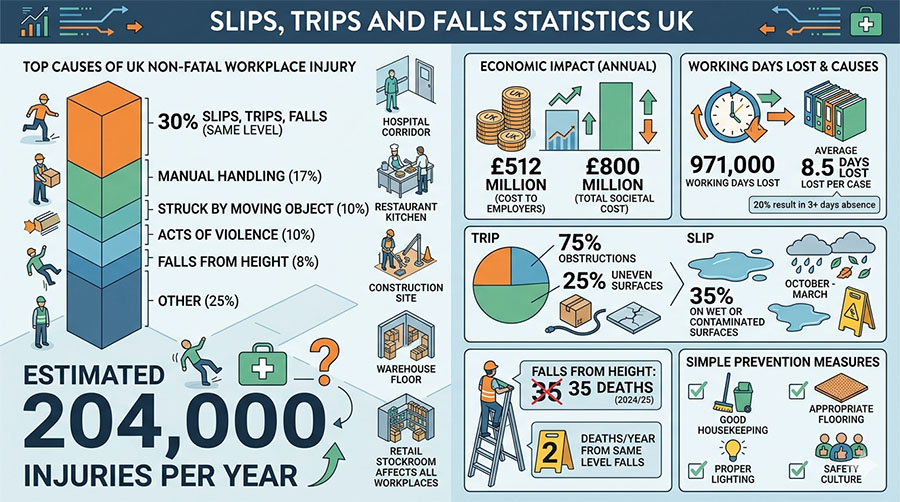
- 30% of all non-fatal workplace injuries in Great Britain are slips, trips and falls on the same level — the single most common cause, ahead of manual handling (17%), struck by moving object (10%), acts of violence (10%) and falls from height (8%).
- ~204,000 workplace injuries per year are caused by slips, trips and falls on the same level, based on an estimated 680,000 non-fatal workplace injuries in 2024/25.
- 35 deaths in 2024/25 from falls from height — a related but distinct category accounting for a further 8% of non-fatal injuries and the leading cause of workplace fatalities.
- ~2 fatalities per year are caused directly by slips, trips and falls on the same level, which also contribute to further deaths as initiating events in other accidents.
- 971,000 working days were lost to slip, trip and fall injuries in a recent three-year period (2017/18–2019/20), averaging approximately 8.5 days lost per case.
- 20% of all slip, trip and fall injuries result in the employee being absent from work for three or more days.
- £512 million per year is the cost to UK employers in lost production and associated costs, with the total societal cost estimated at around £800 million per year by the HSE.
- Highest rate of non-fatal workplace injuries of any industry in 2024/25 was recorded by accommodation and food service, with slips, trips and falls a primary driver.
- 75% of trips in the workplace are caused by obstructions; the remaining 25% by uneven surfaces.
- 35% of slips occur on wet or contaminated surfaces, with the majority happening during the wetter months of October to March.
How Common Are Slips, Trips and Falls at Work?
Slips, trips and falls have been the leading cause of non-fatal workplace injury in the UK for many years. The latest HSE figures confirm that this pattern has not changed:
- In 2024/25, slips, trips and falls on the same level accounted for 30% of all non-fatal workplace injuries — the highest proportion of any single cause.
- This means that across an estimated 680,000 non-fatal workplace injuries, approximately 204,000 were the result of a slip, trip or fall on the same level.
- When falls from height (a further 8%) are included, the combined total rises to approximately 38% of all non-fatal workplace injuries — meaning more than one in three workplace injuries involves a fall of some kind.
- Slips and trips are also frequently described as initiating events in accidents attributed to other causes. A worker who trips may fall into machinery, knock over chemicals, or fall from a low platform — meaning the true contribution of slips and trips to the broader injury picture is larger than the headline figures suggest.
- In a historical comparison, slips, trips and falls accounted for 37% of reported workplace injuries in 2010, compared to around 30% in the most recent data — a meaningful reduction, but one that still leaves hundreds of thousands of workers injured each year.
Slips, Trips and Falls vs. Falls from Height
It is important to distinguish between two related but distinct categories within the HSE data:
Slips, trips and falls on the same level — the subject of this guide — cover incidents where a worker slips on a contaminated floor, trips over an obstruction, or falls while walking on a flat surface. These are the most common type of fall, responsible for approximately 30% of non-fatal injuries, and relatively rarely cause direct fatalities.
Falls from height — a separate and more severe category — cover incidents where a worker falls from scaffolding, ladders, roofs, mezzanine floors, or any elevated surface. These account for 8% of non-fatal injuries but are the leading cause of workplace fatalities, responsible for 35 deaths in 2024/25 and more than a quarter of all worker deaths. Falls from height have been the number one cause of workplace death for the majority of years since 2001/02. In construction, falls from height account for more than half of all sector fatalities across the five-year average.
Both categories require active management by employers, but the risks, control measures, and legislative frameworks that apply to each are distinct.
Working Days Lost
The productivity impact of slips, trips and falls in UK workplaces is substantial:
- During the three-year period 2017/18 to 2019/20, an estimated 971,000 working days were lost to slip, trip and fall injuries — an average of approximately 323,000 lost days per year from this cause alone.
- Each affected worker loses an average of 8.5 working days per slip, trip or fall injury.
- One in five (20%) slip, trip and fall injuries results in the employee being absent from work for three days or more.
- The total working days lost across all non-fatal workplace injuries was 4.1 million days in 2024/25, with slips, trips and falls the single largest injury category.
- These figures do not capture the broader costs of reduced productivity among those who return to work before fully recovering, nor the management time, administrative burden, and operational disruption that follow any workplace injury.
- When falls from height are added to same-level slips, trips and falls, the combined contribution to workplace absence is substantially higher still.
The Cost to UK Businesses and Society
Slips, trips and falls impose significant financial costs at every level:
- The HSE estimates that slips, trips and falls cost UK employers approximately £512 million per year in lost production and other direct costs.
- The total societal cost — including NHS treatment, individual income loss, and wider economic impact — is estimated at around £800 million per year.
- These figures are likely conservative given the significant underreporting of workplace injuries (see the section on the reporting gap below).
- Employers also face compensation claims from injured workers, with settlements for serious slip, trip or fall injuries varying widely depending on severity. Fractures, spinal injuries, and long-term mobility issues resulting from workplace falls can attract significant awards.
- Beyond direct financial costs, slips, trips and falls generate reputational risk, increased insurance premiums, regulatory scrutiny, and in serious cases, HSE investigation and potential prosecution.
- The industries hit hardest financially — hospitality, retail, food manufacturing, healthcare, and construction — are also those with the thinnest operating margins and the least capacity to absorb unplanned absence and compensation costs.
Which Industries Are Most Affected?
Slips, trips and falls affect virtually every industry, but certain sectors record consistently higher rates. HSE data identifies the following as particularly high-risk environments:
Accommodation and food service (hospitality and catering) recorded the highest rate of non-fatal workplace injuries of any industry in 2024/25. Wet floors from spillages, food preparation areas, fast-paced working conditions, and inadequate footwear all contribute to a very high slip and trip rate. Slips and trips are among the primary causes of injury in this sector.
Construction has above-average non-fatal injury rates, with slips and trips on the same level a significant contributor alongside the more high-profile hazard of falls from height. Site conditions — uneven ground, wet surfaces, cables and materials left on walkways — create persistent trip hazards.
Transportation and storage — including warehousing and logistics — records high rates of STF injuries, with 684 injuries per 100,000 workers over the period 2014–2023. Loading dock areas, vehicle bays, and warehouse floors with spillages, debris, or uneven surfaces are common risk environments.
Human health and social work — hospitals and care settings — face significant slip and trip risks due to wet floors, spill-prone clinical environments, long walking distances, and the physical demands of patient care. Research published in occupational health literature confirms that a substantial proportion of NHS staff STF injuries are specifically caused by slipping rather than tripping.
Food manufacturing is consistently identified by the HSE as a high-risk sector for slips and trips, given the prevalence of liquid contamination, oils, and food products on floor surfaces throughout production processes.
Retail — particularly in stockrooms and behind service counters — generates a high volume of slip and trip incidents through poor housekeeping, boxes left on walkways, and wet entrances and exits.
Water supply, sewerage and waste management records the highest rate of STF injuries by industry per 100,000 workers, reflecting the often wet, outdoor, and physically demanding nature of the work.
The Main Causes of Slips, Trips and Falls
Understanding the specific causes of slips, trips and falls helps employers target prevention effectively. HSE research identifies the following as the most common contributors:
For slips:
- Wet or contaminated floors — the most common cause, responsible for 35% of slips. Fluid leaks from machinery, food production residues, rainwater tracked in from outside, and spillages are all common sources of contamination.
- Inadequate or worn flooring — surfaces that have become smooth over time, or that were never appropriate for the environment, contribute significantly to slip risk.
- Inappropriate footwear — workers without slip-resistant footwear are substantially more likely to slip on wet or contaminated surfaces.
- Poor lighting — reduces workers’ ability to identify wet areas or hazards in time to avoid them.
- Rush and time pressure — workers who are hurrying are more likely to slip, particularly on surfaces they know to be hazardous.
- Seasonal factors — the majority of slips occur during the wetter months (October to March), when rainwater and mud are tracked into buildings more frequently.
For trips:
- Obstructions on walkways — 75% of workplace trips are caused by obstructions. Cables, boxes, packing materials, tools, and equipment left on pedestrian routes are the most common culprits.
- Uneven surfaces — the remaining 25% of trips are attributable to uneven flooring, raised thresholds, damaged surfaces, or changes in floor level that are not adequately signposted or lit.
- Poor housekeeping — described by the HSE as the most common root cause of trips in the workplace. Most trip hazards are created by human behaviour, not structural deficiencies.
Slips, Trips and Falls and Fatal Injuries
While slips, trips and falls on the same level directly cause relatively few deaths, their contribution to workplace fatality is more significant than the headline figures suggest:
- Falls from height — which often begin as a slip or trip — are the leading cause of workplace death in the UK, responsible for 35 fatalities in 2024/25 and accounting for 28% of all worker deaths.
- The five-year average for falls from height deaths stands at 38 per year.
- Slips, trips and falls on the same level cause approximately 2 direct worker fatalities per year — but they also act as initiating events in accidents involving machinery, hazardous substances, and working at height, meaning their contribution to total fatality figures is understated.
- In construction, where the risk of working near edges and at height is constant, a slip or trip that would be a minor incident on a factory floor can be fatal. Falls from height account for more than half of all construction fatalities across the five-year average.
- 92 members of the public were killed in work-related incidents in 2024/25, with a proportion of these involving slips, trips and falls in public-facing environments including retail, hospitality, and public buildings — environments where employers have a duty of care to visitors and customers as well as staff.
The Reporting Gap: How Many Go Unrecorded?
A critical feature of slip, trip and fall data is the substantial gap between official reported figures and the true number of incidents:
- In a recent year, employers formally reported approximately 19,400 slip, trip and fall injuries under RIDDOR — the mandatory reporting framework.
- However, the Labour Force Survey — the HSE’s preferred broader data source — estimated approximately 179,520 slips, trips and falls occurring in the same period, based on applying the same proportional rate to self-reported total injury figures.
- This suggests that only around one in nine workplace slip, trip and fall injuries is formally reported by employers under RIDDOR.
- The reporting gap reflects several factors: many injuries fall below the RIDDOR threshold (injuries not resulting in more than seven days’ absence); some employers do not report injuries they are legally required to report; and workers sometimes choose not to formally report minor incidents.
- The HSE states it is 95% confident that its Labour Force Survey estimates represent the actual population figure — making the self-reported figures the more reliable measure of true prevalence.
Employer Legal Duties
Employers have clear and enforceable legal obligations to manage slip, trip and fall risks in their workplaces. Key legislation includes:
- The Workplace (Health, Safety and Welfare) Regulations 1992 — require employers to ensure that floors and traffic routes are suitable, in good condition, and properly maintained so that people can move around safely. Floors must be free from obstructions, and slippery areas must not pose a risk to workers.
- The Health and Safety at Work etc. Act 1974 — places a general duty on employers to ensure, so far as is reasonably practicable, the health, safety, and welfare of all employees and others affected by their work — including members of the public and visitors.
- The Management of Health and Safety at Work Regulations 1999 — require employers to carry out suitable risk assessments of all workplace hazards, including slip, trip and fall risks, and to implement appropriate controls.
- The Work at Height Regulations 2005 — apply specifically to falls from height, requiring employers to avoid work at height where possible, use appropriate equipment where it cannot be avoided, and ensure workers are competent and properly trained.
- RIDDOR 2013 — requires employers to formally report specified workplace injuries, including those resulting in more than seven days’ absence, to the HSE.
Failure to manage slip, trip and fall hazards can result in HSE investigation, enforcement notices, and prosecution. Where a member of the public is injured on business premises as a result of a slip or trip, employers may also face civil liability claims under the Occupiers’ Liability Acts 1957 and 1984.
Preventing Slips, Trips and Falls: What Works
The evidence base for slip, trip and fall prevention is mature and well established. The HSE’s long-running Shattered Lives campaign, and substantial occupational health research, point consistently to the same set of effective interventions.
For Employers
Address contamination at source. The most effective approach to preventing slips is not cleaning up spills after they occur, but preventing contamination reaching the floor in the first place through drainage, containment, and process redesign.
Specify appropriate flooring. Floor surfaces should be selected and maintained with both cleaning requirements and slip resistance in mind. Anti-slip flooring, matting at entrances, and regular inspection of floor condition are all effective controls.
Provide slip-resistant footwear. Research including a randomised controlled trial conducted in NHS settings confirms that slip-resistant footwear significantly reduces slipping injuries among workers in wet environments. Footwear programmes that provide footwear at no cost to workers are particularly effective.
Maintain rigorous housekeeping standards. Since 75% of trips are caused by obstructions, good housekeeping is the single most impactful trip prevention measure. Clear policies on keeping walkways free, prompt removal of waste and packaging, and cable management all contribute substantially.
Ensure adequate lighting. Poor lighting prevents workers from identifying hazards in time to avoid them. Lighting standards should be maintained across all walkways, stairways, and work areas.
Conduct regular risk assessments. Risks change seasonally, as work processes change, and as premises age. Regular assessment ensures that new hazards are identified and addressed promptly.
Train workers and supervisors. Training should cover not only how to avoid slips and trips, but how to report hazards so that they can be addressed before they cause injury.
For Workers
- Report spills, obstructions, and damaged flooring promptly — do not assume someone else will deal with them
- Wear appropriate footwear for your environment
- Keep walkways clear — return materials, tools, and equipment to their designated storage after use
- Take extra care during wet weather and when entering from outside
- Use handrails on stairs and ramps
- Slow down in areas known to be hazardous, particularly when carrying loads that restrict your field of view
Written by Workplace Safety Experts
This guide was produced by the team at Manual Handling Training, a UK provider of RoSPA-approved and CPD-accredited online health and safety training. While our specialism is manual handling, slips, trips and falls frequently occur in exactly the same environments — warehouses, manufacturing sites, healthcare settings, and logistics operations — and understanding the data that underpins the risk is essential for any employer or safety professional managing a physical workplace.
Related guides
Sources & references
- Health and Safety Executive (HSE) – Health and Safety at Work: Summary Statistics for Great Britain 2025: hse.gov.uk/statistics
- Health and Safety Executive (HSE) – Slips and Trips: The Importance of Floor Surfaces: hse.gov.uk/slips
- Health and Safety Executive (HSE) – Non-Fatal Injuries at Work in Great Britain: hse.gov.uk/statistics/causinj
- Health and Safety Executive (HSE) – Work-Related Fatal Injuries in Great Britain 2024/25: hse.gov.uk/statistics/fatals
- British Safety Council – Don’t Fall Short on Slips and Trips (2022): britsafe.org
- IOSH Magazine – Taking Stock of Trips (January/February 2025): ioshmagazine.com
- HSE – Workplace (Health, Safety and Welfare) Regulations 1992: hse.gov.uk/workplace-health-safety-welfare
- HSE – Work at Height Regulations 2005: hse.gov.uk/work-at-height
Make sure your team is trained in safe manual handling.
Explore the Manual Handling Training Course →
Mark writes about workplace health & safety, manual handling and accredited online training for Manual Handling Training, part of Online CPD Academy.