
Warehouse accidents statistics UK
Warehousing and logistics is one of the UK’s most physically demanding and accident-prone sectors. The combination of heavy goods, powered vehicles, manual handling, shift work, high throughput targets, and the pressure of e-commerce demand creates an environment where the potential for serious injury is present throughout every working day.
The UK’s transportation and storage sector — the HSE category that covers warehousing, distribution centres, freight handling, and logistics operations — consistently records injury and fatality rates significantly above the national average. Forklift trucks, manual handling, slips, falls from height, and being struck by moving vehicles are responsible for the majority of incidents, many of which result in life-changing or fatal injuries.
This guide brings together the latest verified UK warehouse accident statistics from the Health and Safety Executive (HSE), the British Safety Council, and industry data — covering injury rates, causes, affected groups, costs, and what the evidence shows about prevention.
These figures are the latest available from official UK statistics, and this page is reviewed and updated as new data is published.
Key facts & figures (overview)
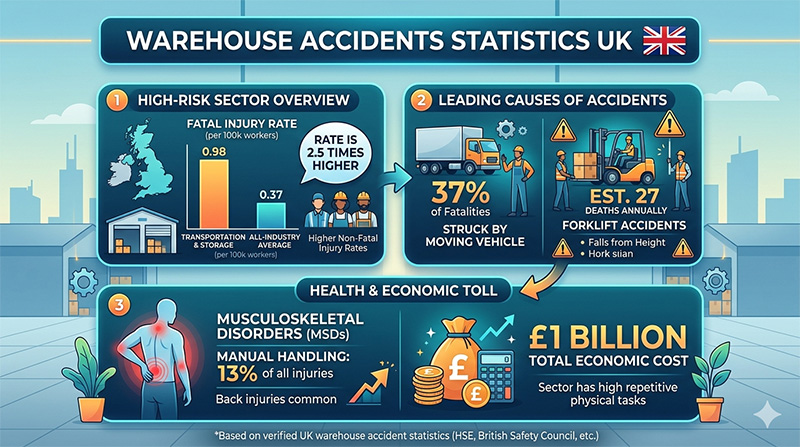
- 0.98 per 100,000 workers — the fatal injury rate in transportation and storage in 2024/25, approximately 2.5 times the all-industry average of 0.37.
- 15 fatal injuries to workers in the transportation and storage sector in 2024/25.
- 38,000 workplace injuries occur in the transportation and storage sector annually (estimated).
- 37% of fatal accidents in transportation and storage are caused by being struck by a moving vehicle — the most common cause of sector fatalities.
- 27 workers are killed in forklift truck accidents across UK workplaces every year (estimated).
- 1,300 workers are hospitalised with severe injuries following forklift accidents every year in the UK, according to the British Safety Council.
- 43% of all forklift incidents involve impacts with a third person — predominantly pedestrians on unrelated tasks.
- 13% — manual handling’s approximate share of all injuries in the transportation and storage sector, with back injuries and upper limb disorders among the most common outcomes.
- £1 billion — the total economic cost of workplace ill health and injury in the transportation and storage sector in the most recent HSE sector estimate.
Transportation and storage also has higher-than-average rates of musculoskeletal disorders (MSDs), with workers in the sector among the most exposed to heavy manual handling and repetitive physical tasks in the UK economy. The sector records above-average non-fatal injury rates compared to the all-industry average and is consistently identified by HSE as one of the highest-risk sectors.
The transportation and storage sector: scale and risk
The HSE classifies warehousing, distribution, and logistics operations under the transportation and storage sector — a broad category covering road haulage, rail freight, air cargo, port operations, warehousing, and postal and courier services. The UK logistics sector employs well over two million people, making it one of the country’s largest employers.
The sector has grown substantially over the past decade, driven primarily by the rapid expansion of e-commerce. The volume of parcels handled by UK warehouses and fulfilment centres has increased dramatically, placing greater physical demands on the workforce and — in some cases — creating new safety challenges as employers scale up operations faster than their safety management systems can adapt.
Key characteristics that make warehousing particularly hazardous include:
- The co-existence of pedestrians and powered vehicles in shared spaces, often at pace
- High volumes of manual handling — lifting, carrying, pushing, and pulling goods throughout every shift
- Work at height — using racking systems, mezzanine floors, loading docks, and order-picking equipment
- Shift patterns and time pressure — night shifts, peak season surge periods, and productivity targets that can encourage risk-taking
- High staff turnover and agency workers — who may receive less thorough induction and safety training than permanent employees
- Increasingly automated environments — introducing new interaction risks between workers and automated guided vehicles, conveyors, and robotic systems
Across these risk factors, the HSE data consistently identifies transportation and storage as recording above-average non-fatal injury rates compared to the all-industry average.
Fatal injuries in UK warehouses and logistics
- In 2024/25, 15 workers were killed in the transportation and storage sector — down from 18 the previous year.
- The sector’s fatal injury rate of 0.98 per 100,000 workers is approximately 2.5 times the all-industry average, making it one of the most dangerous sectors relative to workforce size.
- Transportation and storage consistently ranks among the top sectors by both the number and rate of fatalities, alongside construction and agriculture.
- One in ten workplace fatalities in the UK occurs in the transportation and storage sector.
- Vehicle-related incidents — workers being struck by moving vehicles, loading accidents, and vehicle overturns — are the primary cause of sector fatalities.
- The five-year average for fatal injuries in the transportation and storage sector is approximately 15 per year, though year-on-year variation is significant given the relatively small absolute numbers.
- Loading docks and loading/unloading operations are consistently identified as high-risk locations within warehouses, where the interaction between visiting vehicle drivers, warehouse staff, and moving equipment creates complex hazard scenarios.
The leading causes of warehouse accidents
HSE data and RIDDOR reporting identify the following as the primary causes of serious and fatal injuries in warehousing and logistics environments:
Being struck by a moving vehicle: The single most common cause of fatal accidents in the transportation and storage sector, responsible for 37% of sector fatalities. This includes workers being struck by forklifts, HGVs, pallet trucks, and other powered vehicles — most frequently as a result of inadequate pedestrian-vehicle segregation.
Manual handling: Lifting, carrying, pushing, and pulling heavy or awkward loads is responsible for approximately 13% of all injuries in the sector. Warehouse picking and packing roles — particularly in high-volume e-commerce fulfilment — involve thousands of repetitive movements per shift, driving both acute injuries and cumulative musculoskeletal disorders.
Slips, trips and falls on the same level: Responsible for 30% of all non-fatal workplace injuries nationally, and proportionally significant in warehouses where wet loading dock areas, uneven surfaces, poorly lit aisles, and obstructions on walkways create constant trip hazards.
Falls from height: Occurring from racking systems, mezzanine floors, loading platforms, and order-picking equipment. Falls from height are the leading cause of workplace death nationally, and warehouses present numerous scenarios — particularly pallet racking access — where falls can be fatal.
Being struck by falling objects: Racking collapse, unstable loads, and objects falling from height during picking operations are a persistent hazard. Racking systems should be visually inspected at least monthly by a competent person, and load capacities must be strictly observed.
Contact with moving machinery: Conveyors, compactors, wrapping machines, and automated systems all present entrapment and contact risks, particularly when maintenance is undertaken or when safety guards are bypassed.
Forklift and workplace transport accidents
Forklift trucks and other powered industrial vehicles are responsible for a disproportionate share of the most serious injuries and fatalities in UK warehouses. The statistics are stark:
- An estimated 27 workers are killed in forklift truck accidents every year in the UK.
- 1 in 5 workplace fatalities across all UK industries is caused by a forklift truck or industrial vehicle.
- 1,300 workers are hospitalised with severe injuries following forklift accidents annually, according to the British Safety Council.
- 1,500 injuries are caused by forklifts and other industrial vehicles every year in the UK.
- 3 in 10 of all forklift-related injuries in the UK occur in the transportation and storage sector.
The pedestrian collision problem
RIDDOR data over a three-year period found that 43% of all forklift incidents involved impacts with a third person. The breakdown of who those third parties were is instructive:
| Third party struck | Share of forklift impact incidents |
|---|---|
| Pedestrians engaged in activities completely unrelated to the forklift’s immediate operation | 65% |
| Co-workers or supervisors | 20% |
| Delivery drivers watching or assisting with loading/unloading their vehicles | 15% |
This means that the majority of forklift impact incidents involve people who had no reason to be near the forklift at all — a pattern that points directly to inadequate pedestrian segregation as the root cause rather than operator error alone.
Why forklifts are particularly dangerous
Forklifts appear deceptively compact but carry dense counterweights that make them heavier than most road vehicles of equivalent size. In high-throughput operations, forklift speeds may be de-restricted to allow travel of up to 18 mph. Their turning radius, the load they carry, and their limited driver visibility — particularly when reversing or carrying elevated loads — create serious hazard combinations in environments where pedestrians are present.
Around a quarter of all workplace transport accidents involve forklift trucks, with a significant proportion involving drivers being crushed after the vehicle overturns — particularly where seatbelts are not being worn.
Manual handling injuries in warehouses
Manual handling is at the heart of most warehouse operations, and it is one of the leading drivers of both acute injury and long-term ill health in the sector:
- Manual handling accounts for approximately 13% of all injuries in the transportation and storage sector.
- Nationally, handling, lifting and carrying accounts for 17% of all non-fatal workplace injuries — making it the second most common cause of workplace injury after slips, trips and falls.
- Transportation and storage workers are among the highest-risk occupational groups for work-related musculoskeletal disorders (MSDs), with the sector specifically identified by the HSE as having above-average MSD rates.
- The most common MSD outcomes in warehouse settings include back injuries (43% of all MSD cases nationally), upper limb and shoulder conditions (41%), and lower limb problems from prolonged standing and repetitive movement.
- In order-picking roles — one of the most physically intensive warehouse tasks — workers may walk 10–15 miles per shift while repeatedly bending, reaching, and lifting. This level of physical demand, sustained over months and years, drives high rates of cumulative injury.
- Agency and temporary workers — who make up a significant proportion of the warehouse workforce, particularly during peak season — are at higher risk because they may receive less thorough manual handling training during induction and may be placed immediately into high-demand picking roles.
- The Manual Handling Operations Regulations 1992 require employers to avoid hazardous manual handling where reasonably practicable, assess unavoidable tasks, and reduce risk — yet compliance in fast-moving warehouse environments remains patchy.
Slips, trips and falls
Warehouses contain a high concentration of slip, trip and fall hazards that persist throughout operational hours:
- Slips, trips and falls on the same level are responsible for 30% of all non-fatal workplace injuries nationally — and warehouses generate a high share of these incidents.
- Loading dock areas — where rain, condensation, and spilled goods create wet surfaces that are particularly hazardous when workers are also handling heavy loads
- Aisle obstructions — packaging materials, broken pallets, strapping, and misplaced stock left on pedestrian routes
- Poor lighting — particularly in older facilities, overnight shifts, or low-traffic storage areas
- Uneven surfaces and damaged flooring — in high-traffic areas where pallet truck and forklift movement gradually damages floor surfaces
- Changes in floor level — between loading dock areas and warehouse floors, at mezzanine access points, and at ramp transitions
OSHA estimates that approximately a quarter of all warehouse accidents take place in loading dock areas — the zone where the interaction between external vehicles, internal powered equipment, and manual handling converges.
Falls from height
Falls from height are the leading cause of workplace death nationally, and warehouse operations present multiple scenarios where working at height cannot be avoided:
- Falls from pallet racking — including workers climbing racking structures to retrieve goods, using unsecured ladders in picking aisles, or standing on forklift forks to access elevated positions. Standing on forklift forks to access height is specifically identified by the HSE as a regular cause of fatal injury in warehouse and storage facilities and is prohibited.
- Loading dock falls — where workers fall from raised loading bays into yard areas. Loading docks require fall protection measures including edge protection, dock levellers, and clear systems of work.
- Mezzanine floor falls — mezzanine levels are common in modern warehouses for storage or pick-pack operations. Falls from mezzanine edges without adequate guarding are a serious and recurring hazard.
- Order-picking equipment — reach trucks, order-pickers, and mobile elevated work platforms (MEWPs) all involve working at height with specific risks of fall or ejection from the platform.
Falls from height account for more than a quarter of all workplace fatalities nationally. In the warehousing context, the combination of routine access to height, time pressure, and variable skill levels in the workforce make falls from height one of the most preventable categories of serious injury.
Warehouse ill health: the overlooked risk
Beyond acute injuries, warehouse workers face significant risks of work-related ill health that develop gradually and are less visible than accidents but equally damaging:
Musculoskeletal disorders: Transportation and storage workers have above-average MSD rates compared to the national average, driven by the physical demands of picking, packing, loading, and unloading. Back injuries are the most common outcome, but upper limb conditions — particularly in repetitive scanning and packing roles — are a growing concern.
Work-related stress: The sector sees an estimated 30,000 workplace-related illnesses per year across transportation and storage. The combination of physical demands, shift working, high throughput targets, and performance monitoring in large fulfilment operations is increasingly cited as a driver of work-related stress among warehouse workers.
Noise-induced hearing loss: Warehouses often contain equipment — forklifts, conveyors, compressors, balers, and packaging machinery — that generates potentially harmful noise levels. Workers regularly exposed to noise above 80dB require hearing protection to be made available; above 85dB it becomes mandatory.
Whole-body vibration: Workers who drive forklifts, pallet trucks, and other powered vehicles for extended periods are exposed to whole-body vibration — a recognised cause of lower back pain and other musculoskeletal conditions. The Control of Vibration at Work Regulations 2005 require employers to assess and control vibration exposure.
Cold and heat stress: Temperature-controlled warehouses — frozen food distribution, pharmaceutical logistics — expose workers to sustained cold that exacerbates musculoskeletal conditions and affects manual dexterity. Conversely, large ambient warehouses in summer can generate heat stress during intensive physical work.
E-commerce growth and the changing risk landscape
The rapid expansion of e-commerce has transformed the UK warehousing sector over the past decade — and with it, the nature and scale of the safety challenge:
- The volume of goods handled by UK warehouses has grown dramatically as online retail has become the dominant channel for many product categories, placing greater physical demands on larger workforces operating at higher throughput rates.
- Analysis has found that large e-commerce fulfilment centres can record injury rates significantly higher than traditional warehouses. One widely cited report found injury rates at major e-commerce operations were more than double those of comparable warehouse facilities — a pattern attributed to the intensity and pace of picking operations and the use of algorithmic productivity monitoring.
- High turnover rates in the sector mean that a significant proportion of the workforce is always new — often placed into physical roles before they have developed the ergonomic awareness, technique, or physical conditioning to perform them safely over sustained periods.
- Seasonal peak demand — particularly in the run-up to Christmas — creates pressure to bring in large numbers of agency and temporary workers at short notice. These workers may have limited warehouse experience, reduced induction, and less time to adapt to the physical demands before high-throughput working begins.
- The introduction of automation, robotics, and automated guided vehicles (AGVs) in advanced fulfilment centres changes but does not eliminate the risk landscape — creating new interaction hazards between human workers and autonomous systems, particularly in facilities where the transition from manual to automated operations is incomplete.
The cost of warehouse accidents
The financial burden of warehouse accidents falls on employers, workers, the NHS, and the broader economy:
- The total economic cost of workplace ill health and injury in the transportation and storage sector was estimated at £1 billion in the most recent HSE sector cost estimate (2021/22).
- Nationally, manual handling injuries — the most significant single injury driver in warehousing — cost UK businesses an estimated £3.5 billion per year in lost productivity, compensation, and healthcare costs.
Forklift-related prosecutions consistently result in substantial fines. Recent examples include:
- A company fined £1.2 million after an HGV driver was fatally crushed by an overloaded forklift that overturned
- A company fined £500,000 following the death of a man when a forklift overturned due to failure to enforce seatbelt use
- A company fined £600,000 after an employee suffered life-changing injuries from being struck by a forklift
- A company fined £400,000 after a worker was seriously injured by a forklift while walking on site
Beyond fines, warehouse operators face civil compensation claims from injured workers, increased Employer’s Liability Insurance premiums following claims, operational disruption, and reputational damage — all of which substantially exceed the cost of the safety controls that would have prevented the incident.
Which workers are most at risk?
Not all warehouse workers face equal risk. The data points to several groups with disproportionately high exposure:
Agency and temporary workers are at consistently higher risk due to shorter inductions, less time to develop site-specific safety awareness, and placement in demanding physical roles at pace. Safety obligations apply equally to agency workers — both the employment agency and the host employer share responsibility for their health and safety.
New starters — regardless of employment type — are more likely to be injured before they have fully internalised site hazards, established safe habits, and built the physical conditioning necessary for sustained manual handling work. Induction quality and supervised onboarding are critical risk factors.
Night shift workers face heightened risk due to fatigue, reduced staffing levels, and lower supervisor-to-worker ratios. Many serious warehouse incidents occur during overnight or early morning shifts.
Delivery drivers and visiting workers are at significant risk from the hazards of unfamiliar sites. As RIDDOR data shows, 15% of forklift impact victims are delivery drivers watching or assisting with loading operations. Site induction for all visiting workers is a legal requirement that is frequently inadequate in practice.
Older workers — as with the broader workforce, workers aged 60 and over face fatal injury rates approximately twice the average, even after controlling for other factors. Age-related changes in physical strength, reaction time, and recovery rate increase vulnerability.
Employer legal duties
Employers operating warehouses in the UK must comply with a comprehensive framework of health and safety legislation:
- The Health and Safety at Work etc. Act 1974 — the foundational duty to ensure, so far as is reasonably practicable, the health, safety, and welfare of all workers and others on the premises.
- The Management of Health and Safety at Work Regulations 1999 — requiring suitable and sufficient risk assessments for all significant hazards, including vehicle-pedestrian interaction, manual handling, and work at height.
- The Manual Handling Operations Regulations 1992 — requiring employers to avoid hazardous manual handling where reasonably practicable and to assess and reduce the risk of unavoidable tasks.
- The Workplace (Health, Safety and Welfare) Regulations 1992 — requiring traffic routes to be organised so that pedestrians and vehicles can circulate safely, and that floors and walkways are maintained in safe condition.
- The Provision and Use of Work Equipment Regulations 1998 (PUWER) — covering forklifts, conveyors, pallet trucks, and all other workplace equipment, requiring safe maintenance, guarding, and operator competence.
- The Work at Height Regulations 2005 — requiring employers to avoid work at height where possible, and to use appropriate equipment and controls where it cannot be avoided.
- The Control of Vibration at Work Regulations 2005 — requiring assessment and control of whole-body vibration exposure for forklift and vehicle operators.
- RIDDOR 2013 — requiring employers to report fatal and specified serious injuries, including forklift accidents, to the HSE.
- HSE Approved Code of Practice L117 (Rider-operated Lift Trucks) — the definitive guidance on safe forklift operation, including pedestrian segregation requirements. While an ACOP is not legally binding in itself, failure to follow it can be used as evidence of a breach in prosecution proceedings.
Preventing warehouse accidents: what works
The causes of warehouse accidents are well understood, and the interventions that prevent them are well established. The concentration of fatalities and serious injuries in a small number of hazard categories — vehicle-pedestrian collisions, manual handling, falls from height — points clearly to where effort must be focused.
Workplace transport and forklift safety
- Achieve complete physical segregation of pedestrians and powered vehicles wherever possible, using barriers, designated lanes, and separate access routes
- Where complete segregation is not possible, implement clear floor markings, audible warning systems, presence-sensing technology, and controlled crossing points
- Enforce seatbelt use by all forklift operators — a significant proportion of fatal forklift overturns result in deaths that would have been survivable with a seatbelt worn
- Ensure all forklift operators hold valid certificates from accredited training providers
- Conduct documented daily pre-use checks on all powered industrial vehicles
- Implement and enforce a traffic management plan covering all vehicle movements in yards, loading areas, and internal aisles
- Provide a thorough site safety induction for all visiting drivers covering vehicle routes, waiting areas, and the prohibition on entering forklift operating zones
Manual handling
- Conduct manual handling risk assessments for all tasks involving significant lifting, carrying, pushing, or pulling
- Reduce the need for manual handling through mechanical aids — pallet trucks, pump trucks, conveyors, and lifting equipment
- Provide role-specific manual handling training at induction and on a regular refresh basis
- Monitor picking rate targets and ensure they do not incentivise unsafe techniques or discourage reporting of pain
Slips, trips and falls
- Maintain rigorous housekeeping standards — keep aisles clear of packaging, strapping, and debris
- Ensure loading dock areas have adequate drainage and anti-slip surfaces, and that wet surface warnings are used promptly
- Inspect and repair flooring regularly, particularly in high-traffic pallet truck and forklift routes
- Ensure adequate lighting throughout all working areas including picking aisles and loading bays
Falls from height
- Prohibit climbing of pallet racking under any circumstances — provide proper access equipment for all elevated retrieval
- Install edge protection on all mezzanine floors, loading platforms, and elevated work areas
- Ensure all MEWP and order-picker operators are trained and competent
- Conduct regular racking inspections by a competent person, maintain a damage log, and remove damaged sections from service immediately
New starters and agency workers
- Provide a thorough site-specific safety induction before new starters begin work — not a generic online course completed at home
- Supervise new starters on manual handling tasks during an initial period before they work independently at pace
- Apply the same induction and training requirements to agency workers as to permanent employees
Written by workplace safety experts
This guide was produced by the team at Manual Handling Training, a UK provider of RoSPA-approved and CPD-accredited online health and safety training. Manual handling is the most significant occupational health risk in the warehouse and logistics sector, and our training is used by businesses across fulfilment, distribution, and supply chain operations to help workers understand the risks, apply safe techniques, and protect their long-term health. The statistics in this guide reflect the scale of the challenge that warehousing operators face every day — and the scale of the benefit when safety is taken seriously.
Sources & references
- Health and Safety Executive (HSE) – Health and Safety at Work: Summary Statistics for Great Britain 2025
- HSE – Work-Related Fatal Injuries in Great Britain 2024/25
- HSE – Work-Related Musculoskeletal Disorders Statistics in Great Britain 2025
- HSE – Costs to Great Britain of Workplace Injuries and New Cases of Work-Related Ill Health 2023/24
- HSE – Approved Code of Practice L117: Rider-Operated Lift Trucks
- HSE – Workplace Transport Safety (HSG136)
- HSE – Manual Handling Operations Regulations 1992
- British Safety Council – Safer Trucking: Protecting Pedestrians in Industrial Environments
Related guides
Make sure your team is trained in safe manual handling.
Explore the Manual Handling Training Course →
Mark writes about workplace health & safety, manual handling and accredited online training for Manual Handling Training, part of Online CPD Academy.