
Every year, manual handling injuries account for approximately one-third of all workplace accidents in the UK. These preventable injuries cost businesses millions in compensation claims, lost productivity, and staff absences.
The Manual Handling Operations Regulations 1992 require all employers to avoid, assess, and reduce the risk of injury from lifting, carrying, pushing, or pulling tasks in the workplace. These regulations, which came into force in January 1993 and were amended in 2002, apply to virtually every UK workplace where employees handle objects manually.
Understanding these regulations is essential for protecting workers and avoiding costly legal consequences. Employers who fail to comply face significant penalties, whilst proper implementation creates safer workplaces and reduces injury-related costs.
- One-third of all workplace accidents in the UK involve manual handling injuries.
- 17% of all non-fatal workplace injuries in the UK are manual handling injuries.
- 103,000 manual handling incidents occur each year.
- £20,000 maximum fine per offence in the magistrates’ courts.
Key takeaways
- Employers must conduct thorough risk assessments for all manual handling tasks that could cause injury
- Safe handling techniques and comprehensive training programmes are legal requirements under the regulations
- Non-compliance can result in prosecution, hefty fines, and compensation claims from injured employees
What are Manual Handling Operations Regulations?
The Manual Handling Operations Regulations 1992 establish legal requirements for workplace safety when moving loads by hand or bodily force. These regulations create specific duties for employers and employees to prevent injuries from lifting, carrying, pushing, and pulling activities.
Definition and scope of manual handling
Manual handling operations include any activity where workers transport or support loads using physical force. The regulations define this as lifting, putting down, pushing, pulling, carrying, or moving items by hand or bodily force.
The scope covers all workplace situations where employees handle objects manually. This includes moving boxes in warehouses, lifting patients in hospitals, and carrying tools on construction sites.
Manual handling applies to loads of any weight or size. Even light objects can cause injury if handled incorrectly or repeatedly. The regulations recognise that cumulative strain from frequent handling poses significant health risks.
Key activities covered:
- Lifting items from floor to shelf
- Carrying materials between locations
- Pushing wheeled equipment
- Pulling loaded trolleys
- Supporting objects during assembly
Overview of the 1992 regulations (MHOR)
The Manual Handling Operations Regulations 1992 (MHOR) establish a three-step approach for employers. First, they must avoid hazardous manual handling where possible. Second, they must assess risks when manual handling cannot be avoided. Third, they must reduce identified risks to acceptable levels.
Employers must provide suitable training to workers who perform manual handling tasks. This training covers proper techniques, risk awareness, and safe working practices.
The regulations require risk assessments for all manual handling activities that could cause injury. These assessments examine the task, load, working environment, and individual capabilities of workers.
Employer duties include:
- Eliminating manual handling where feasible
- Conducting thorough risk assessments
- Implementing control measures
- Providing appropriate training
- Monitoring workplace practices
Legal status and amendments
MHOR carries full legal force under UK health and safety law. Non-compliance can result in prosecution, fines, and enforcement action by the Health and Safety Executive.
The Health and Safety (Miscellaneous Amendments) Regulations 2002 updated the original 1992 regulations. These amendments clarified duties and aligned requirements with European legislation.
The Deregulation Act 2015 modified requirements for self-employed workers in certain circumstances. The Health and Safety at Work Act 1974 (General Duties of Self-Employed Persons) Regulations 2015 specified when self-employed individuals must comply with manual handling requirements.
Legal framework:
- Primary legislation: Manual Handling Operations Regulations 1992
- Key amendment: Health and Safety (Miscellaneous Amendments) Regulations 2002
- Recent changes: Deregulation Act 2015 provisions
- Enforcement body: Health and Safety Executive
Summary of legal duties and responsibilities
The Manual Handling Operations Regulations 1992 establish clear legal duties for both employers and employees. Employers must avoid, assess and reduce manual handling risks, whilst employees must follow safety procedures and use equipment properly.
Employers’ obligations under MHOR
Employers have three main legal duties under the manual handling regulations. They must avoid manual handling operations where reasonably practicable.
When avoidance is not possible, employers must assess the risks involved. This assessment should examine the task, individual, load and environment factors.
The third duty requires employers to reduce risks to the lowest level reasonably practicable. This involves implementing control measures and providing suitable equipment.
Training requirements form a crucial part of employer obligations. Companies must provide comprehensive training programmes for all employees who perform manual handling tasks.
Risk assessments must be thorough and regular. The Health and Safety Executive requires employers to review assessments when circumstances change or incidents occur.
Employers must also provide appropriate lifting equipment where needed. This includes hoists, trolleys and other mechanical aids to reduce physical strain.
Employees’ roles and responsibilities
Employees have legal duties to cooperate with their employers on workplace safety matters. They must follow the manual handling procedures and training they receive.
Workers must use lifting equipment and safety devices properly when provided. Ignoring or misusing equipment can lead to disciplinary action and potential injury.
Reporting obligations require employees to inform supervisors about hazards or inadequate equipment. This includes reporting pain, discomfort or near-miss incidents.
Employees cannot be required to lift loads that pose unreasonable risks to their health. They have the right to refuse unsafe manual handling tasks.
Self-employed persons must treat themselves as both employer and employee under the regulations. They must assess their own manual handling risks and implement suitable controls.
Manual handling risk assessment methods
The Manual Handling Operations Regulations require employers to systematically assess manual handling risks through structured approaches and specialised tools. These methods help identify hazards and determine appropriate control measures for workplace safety.
The TILE approach explained
The TILE method provides a comprehensive framework for manual handling risk assessment. This approach examines four critical elements that influence injury risk.
Task factors include the frequency of lifting, carrying distances, and awkward postures required. Repetitive movements and prolonged holding increase risk levels significantly.
Individual capability considers the worker’s physical fitness, training level, and any health conditions. Age, strength, and experience with manual handling tasks affect assessment outcomes.
Load characteristics examine weight, size, shape, and stability. Sharp edges, hot surfaces, or unpredictable centre of gravity create additional hazards during handling operations.
Environment factors assess workspace layout, floor conditions, lighting, and temperature. Cramped spaces, wet floors, or poor visibility increase the likelihood of manual handling injuries.
Risk assessment tools and procedures
The Health and Safety Executive provides several specialised tools for manual handling risk assessment. The Manual Handling Assessment Charts (MAC) help evaluate lifting, lowering, carrying, and team handling operations.
Risk filters identify tasks requiring detailed assessment versus those with minimal risk. These screening tools save time whilst ensuring comprehensive coverage of manual handling operations.
Assessment procedures typically begin with generic workplace evaluations using standardised forms. Specific task assessments follow for high-risk activities identified during initial screening.
Documentation requirements include recording assessment findings, control measures implemented, and review dates. Regular reassessment ensures continued effectiveness of risk control strategies.
Controlling and reducing manual handling risks
The first priority is avoiding hazardous manual handling completely where possible. When manual handling cannot be avoided, employers must put control measures in place to reduce injury risk and prevent musculoskeletal disorders.
Avoiding hazardous manual handling
The most effective way to prevent manual handling risks is to eliminate them entirely. Employers should examine each task to see if manual handling is truly necessary.
Mechanical aids can replace many manual tasks. Conveyor belts, hoists, and trolleys reduce the need for workers to lift heavy items. Forklift trucks and pallet jacks handle large loads safely.
Redesigning work processes often removes manual handling. Moving workstations closer together reduces carrying distances. Storing items at waist height prevents bending and reaching.
Automation provides long-term solutions for repetitive tasks. Robotic systems can handle dangerous or heavy materials without putting workers at risk.
Some tasks can be redesigned completely. Changing packaging sizes or delivery methods may eliminate lifting requirements. Rearranging storage areas can prevent awkward movements that cause work-related ill health.
Implementing control measures
When hazardous manual handling cannot be avoided, employers must reduce risks through proper control measures. These measures protect workers from musculoskeletal disorders and other injuries.
Training programmes teach correct lifting techniques and risk awareness. Workers learn to bend their knees, keep loads close to their bodies, and avoid twisting movements. Regular refresher sessions maintain safety standards.
Team lifting reduces individual strain for heavy items. Two or more people can safely handle loads that would injure a single worker. Clear communication between team members prevents accidents.
Mechanical aids still help when some manual handling remains necessary. Lifting belts, grip aids, and shoulder pads reduce physical stress. Height-adjustable platforms bring work to comfortable levels.
Work rotation prevents fatigue-related injuries. Moving workers between different tasks gives muscle groups time to recover. Regular breaks also reduce the risk of strain injuries.
Best practices and safe handling techniques
Proper handling technique forms the foundation of workplace safety, whilst mechanical aids and team-based approaches provide additional layers of protection. These methods work together to reduce injury risk and ensure compliance with manual handling regulations.
Lifting, pushing, pulling, and carrying safely
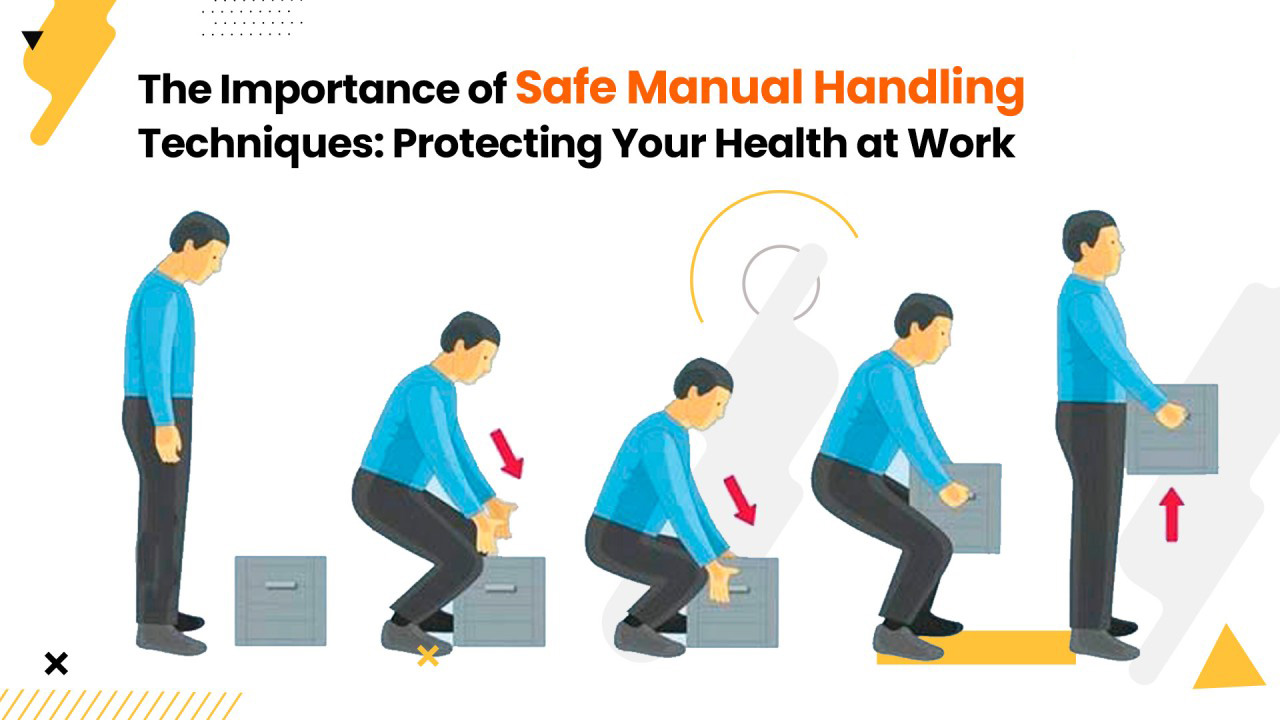
Workers must follow specific techniques for each type of manual handling task. Proper lifting requires bending the knees whilst keeping the back straight and grasping objects close to the body.
For lifting operations, employees should:
- Plant feet firmly shoulder-width apart
- Grip the load securely with both hands
- Rise smoothly using leg muscles
- Avoid twisting the spine during movement
Pushing and pulling tasks demand different approaches. Workers should position themselves close to the load and use their body weight effectively. Push rather than pull when possible, as this provides better control.
Carrying technique involves keeping loads close to the torso. Workers must avoid carrying items above shoulder height or below waist level. Long-distance carrying should be broken into shorter segments with rest periods.
Manual handling training teaches workers to recognise their physical limits. They must never attempt to move loads beyond their capacity alone.
Use of mechanical aids and lifting equipment
Mechanical aids reduce physical strain and minimise injury risk significantly. Lifting equipment includes trolleys, hoists, conveyor belts, and pneumatic lifts.
Employers must provide appropriate mechanical aids where manual handling poses risks. Common equipment types include:
| Equipment type | Best used for |
|---|---|
| Trolleys | Horizontal transportation |
| Hoists | Vertical lifting operations |
| Conveyor systems | Repetitive movement tasks |
| Lifting tables | Height adjustment needs |
Workers require proper training before operating any lifting equipment. Regular maintenance ensures mechanical aids function safely and effectively.
Risk assessment determines which mechanical aids suit specific tasks. Factors include load weight, distance moved, and frequency of handling operations.
Equipment selection must match workplace conditions and load characteristics. Workers should inspect mechanical aids before each use to identify potential faults or damage.
Team handling and ergonomic solutions
Team handling involves multiple workers coordinating to move heavy or awkward loads safely. Clear communication and designated leadership prevent accidents during group lifting operations.
Teams must establish roles before beginning any manual handling task. One person should direct movements whilst others follow instructions precisely. All team members need similar heights and physical capabilities.
Ergonomic solutions modify workplaces to reduce manual handling demands. These include adjustable work surfaces, improved storage layouts, and better lighting conditions.
Workplace design significantly impacts manual handling safety. Storage areas should position frequently used items at waist height. Walkways must remain clear and well-lit.
Manual handling techniques training covers team coordination methods. Workers learn proper communication signals and synchronised movement patterns. Regular practice sessions maintain team handling skills and build confidence amongst staff members.
Consequences of non-compliance
Failing to follow manual handling regulations can lead to serious workplace injuries and significant legal penalties. Manual handling injuries affect thousands of workers each year, whilst non-compliance can result in fines up to £20,000 per offence.
Common manual handling injuries
Manual handling injuries account for approximately 17% of all non-fatal workplace injuries in the UK. This equals around 103,000 incidents each year.
Musculoskeletal disorders represent the most frequent type of injury. These conditions affect nearly half of all work-related ill-health cases.
Common injuries include:
- Back strains and sprains from lifting heavy objects
- Shoulder injuries from repetitive overhead movements
- Neck problems from awkward positioning
- Herniated discs from improper lifting techniques
The risk of injury increases significantly when workers use poor manual handling techniques. Nearly one-third of all workplace injuries in the UK result from inadequate manual handling practices.
These injuries often lead to long-term health problems. Workers may experience chronic pain and reduced mobility. Mental health can also suffer due to ongoing physical limitations.
Legal and financial penalties
Employers who breach manual handling regulations face substantial penalties. The consequences range from financial fines to potential imprisonment in serious cases.
Magistrates’ courts can impose fines between £5,000 and £20,000 per offence. More serious cases may proceed to higher courts with unlimited fines.
Legal consequences include:
- Enforcement notices requiring immediate action
- Prosecution for serious breaches
- Unlimited fines in Crown Court cases
- Custodial sentences for directors in severe cases
Non-compliance also creates additional business costs. Companies face increased absenteeism when workers sustain injuries. Insurance premiums often rise following safety incidents.
Reputational damage can affect future business opportunities. Clients may avoid companies with poor safety records. This impacts long-term profitability and growth prospects.
Improving manual handling in the workplace
Successful workplace safety requires regular training programmes, systematic review of handling practices, and proper incident management systems. These three areas work together to create a culture where moving loads safely becomes standard practice.
Ongoing training and employee involvement
Regular manual handling training keeps workers updated on safe techniques and new equipment. Training should happen when employees start work, change roles, or when new handling methods are introduced.
Effective programmes cover proper lifting posture, team lifting, and equipment use. Workers learn to assess loads before moving them and understand their physical limits.
Key training elements include:
- Correct lifting techniques and body positioning
- Risk assessment skills for different loads
- Equipment operation and maintenance
- Team communication during group lifts
Employee feedback improves training quality. Workers often spot practical problems that managers miss. Regular discussions about handling challenges help identify areas where extra support is needed.
Training works best when it includes hands-on practice with actual workplace equipment. This gives workers confidence to apply techniques correctly when moving loads during normal work.
Reviewing work practices and continuous improvement
Regular workplace assessments identify new risks and outdated practices. Work patterns change over time, creating different handling demands that need fresh approaches.
Monthly reviews should examine handling frequency, load weights, and worker feedback. This data shows where improvements are needed most urgently.
Review areas include:
- Changes in product sizes or weights
- New delivery routes or storage areas
- Equipment condition and effectiveness
- Worker reports of strain or difficulty
Involving workers in reviews provides valuable insights. They understand daily challenges and often suggest practical solutions that reduce physical demands.
Successful improvements might include better storage heights, mechanical aids, or revised work schedules. Small changes often make big differences to worker comfort and safety.
Reporting and managing manual handling incidents
Clear reporting systems help workers report strains, near misses, and equipment problems quickly. Early reporting prevents minor issues becoming serious injuries.
Incident forms should be simple and accessible. Workers need to understand what counts as a reportable event, including minor strains that might worsen over time.
Effective incident management includes:
- Quick medical assessment for injured workers
- Investigation of root causes
- Equipment checks and repairs
- Work practice adjustments
Managers must investigate each incident thoroughly. This means checking equipment, reviewing techniques, and identifying system failures that contributed to the problem.
Follow-up actions prevent similar incidents. This might involve extra training, equipment replacement, or changes to work methods. Sharing lessons learned helps other teams avoid similar problems.
Sources & references
- Manual Handling Operations Regulations 1992 (MHOR)
- Health and Safety (Miscellaneous Amendments) Regulations 2002
- Deregulation Act 2015
- The Health and Safety at Work Act 1974 (General Duties of Self-Employed Persons) Regulations 2015
- Health and Safety Executive (HSE) — Manual Handling Assessment Charts (MAC)
Make sure your team is trained in safe manual handling.
Explore the Manual Handling Training Course →
Mark writes about workplace health & safety, manual handling and accredited online training for Manual Handling Training, part of Online CPD Academy.