
Many workers and employers believe there are strict legal weight limits for lifting at work, but this common assumption is actually incorrect. The law does not set specific maximum weight limits for manual handling activities in the workplace. Instead, UK regulations require employers to assess risks on a case-by-case basis, considering factors like the task, environment, and individual capabilities.
This absence of fixed weight limits often creates confusion and can lead to unsafe practices. Whilst the Health and Safety Executive provides guideline figures to help determine when detailed risk assessments are needed, these are not legal limits but rather indicators for when extra caution is required.
Understanding how manual handling regulations actually work is crucial for both preventing workplace injuries and ensuring legal compliance. The real answer lies in proper risk assessment, safe lifting techniques, and knowing when additional measures are necessary to protect workers from harm.
- 25kg recommended maximum for men in ideal lifting conditions, at waist height with the load held close to the body.
- 16kg recommended maximum for women in ideal lifting conditions, at waist height with the load held close to the body.
- 50% the amount weight limits should be reduced when lifting frequently throughout the day.
- 1992 the year the Manual Handling Operations Regulations established the primary legal duties in the UK.
Key takeaways
- UK law requires risk-based assessments rather than enforcing specific weight limits for manual handling.
- Employers must avoid hazardous manual handling where possible and reduce risks to the lowest practical level.
- Proper training and continuous assessment are essential for preventing musculoskeletal injuries in the workplace.
Understanding manual handling weight limits
Manual handling weight limits provide guidelines for safe lifting practices in the workplace. Different weight limits apply to men and women based on their physical capabilities and the specific lifting conditions.
Definition of a manual handling weight limit
Manual handling weight limits are recommended maximum weights that workers should lift during workplace activities. These guidelines help prevent injuries from lifting, carrying, pushing, or pulling objects.
The law does not set specific weight limits for manual handling. Instead, employers must assess each situation based on the task, the load, and the working environment.
Manual handling includes lifting, putting down, pushing, pulling, carrying, or moving loads by hand or bodily force. The weight limit depends on several factors:
- How close the load is held to the body
- The height at which lifting occurs
- The worker’s individual capability
- The working environment conditions
Risk assessments must consider the position of the load’s centre of gravity. Employers should provide weight information when there is risk of injury and it is practical to do so.
The guidelines aim to reduce injury risk rather than set absolute limits. Each workplace situation requires individual evaluation to determine safe lifting practices.
Recommended weight limits for men
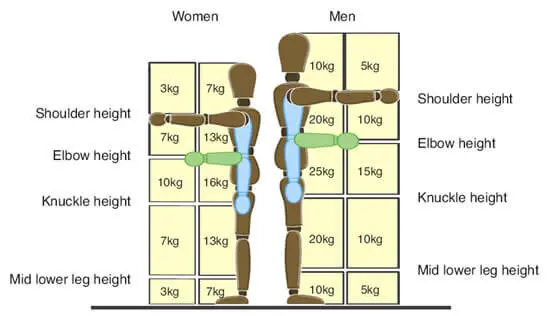
The recommended maximum weight limit for men in ideal lifting conditions is 25kg. This applies when lifting from waist height with the load held close to the body.
Weight limits reduce significantly when lifting conditions are not ideal:
- Lifting above shoulder height: 10kg maximum
- Lifting below knee height: 10kg maximum
- Lifting with arms extended: 10kg maximum
The safe lifting zone for men is between knuckle and shoulder height. Within this zone, the full 25kg limit applies when the load is held close to the body.
Men should reduce the weight limit by 50% when lifting frequently throughout the day. Team lifting may be necessary for loads exceeding individual capacity.
Recommended weight limits for women
The recommended maximum weight limit for women in ideal lifting conditions is 16kg. This applies when lifting from waist height with the load held close to the body.
Women face the same reductions in weight limits under poor lifting conditions:
- Lifting above shoulder height: 7kg maximum
- Lifting below knee height: 7kg maximum
- Lifting with arms extended: 7kg maximum
The safe lifting zone for women is also between knuckle and shoulder height. The full 16kg limit applies only within this zone when loads are held close to the body.
Women should reduce weight limits by 50% for frequent lifting tasks. Mechanical aids or team lifting should be considered for heavier loads to prevent injury.
| Lifting condition | Men | Women |
|---|---|---|
| Ideal conditions (waist height, close to body) | 25kg | 16kg |
| Above shoulder height | 10kg | 7kg |
| Below knee height | 10kg | 7kg |
| Arms extended | 10kg | 7kg |
| Frequent lifting throughout the day | Reduce by 50% | Reduce by 50% |
Legal framework and guidance
The Manual Handling Operations Regulations 1992 establish the primary legal requirements for workplace manual handling in the UK. The Health and Safety Executive provides guidance whilst employers carry specific duties to protect workers from injury.
Manual Handling Operations Regulations 1992
The Manual Handling Operations Regulations 1992 form the cornerstone of UK manual handling law. These regulations require employers to follow a three-step approach to managing manual handling risks.
Employers must first avoid hazardous manual handling operations wherever reasonably practicable. When avoidance is not possible, they must conduct thorough risk assessments of remaining manual handling tasks.
Key requirements:
- Avoid hazardous manual handling where reasonably practicable
- Assess unavoidable manual handling operations
- Reduce risks to the lowest level reasonably practicable
The regulations do not set specific weight limits for lifting operations. Instead, they require case-by-case assessment considering multiple factors including the task, load characteristics, working environment, and individual capabilities.
Role of the Health and Safety Executive (HSE)
The HSE provides guidance to help employers comply with manual handling regulations. They publish detailed guidance documents explaining how to interpret and implement the legal requirements effectively.
HSE guidance emphasises that no universal weight limits exist under the regulations. Instead, they provide guideline figures that indicate when more detailed risk assessments should be carried out for specific operations.
The HSE recommends employers consider:
- Task factors: frequency, duration, posture requirements
- Load characteristics: weight, size, shape, stability
- Working environment: space constraints, floor conditions, lighting
- Individual capability: physical fitness, training, experience
HSE guidance documents include practical tools and checklists to support employers in conducting proper risk assessments and implementing appropriate control measures.
Employer responsibilities
Employers hold primary responsibility for protecting workers from manual handling injuries under the regulations. They must establish systematic approaches to identify, assess, and control manual handling risks across their operations.
Core duties include:
- Conducting suitable and sufficient risk assessments
- Providing appropriate training and information to workers
- Implementing control measures to reduce risks
- Monitoring and reviewing manual handling procedures regularly
Employers must provide workers with information about load weights and centre of gravity positions when injury risks exist and such information is reasonably practicable to obtain.
Training programmes should cover safe lifting techniques, risk recognition, and proper use of mechanical aids. Employers must also consider individual worker capabilities when assigning manual handling tasks and making reasonable adjustments where necessary.
Key factors influencing safe weight limits
Several critical factors determine whether a lifting task poses a risk of injury. These include the nature of the task itself, the person’s physical capabilities, the characteristics of the load, and the working environment.
TILE principle: Task, Individual, Load, Environment
The TILE principle provides a framework for assessing manual handling risks. Each element must be evaluated to determine safe weight limits.
Task considerations include how often lifting occurs and the duration of work. Frequent lifting reduces safe weight limits compared to occasional tasks. The distance objects must be carried also affects risk levels.
Individual factors vary significantly between workers. Age, fitness level, and existing health conditions influence lifting capacity. Previous injuries can reduce a person’s ability to handle certain weights safely.
Load characteristics extend beyond weight alone. The size and shape of objects affect grip quality. Items with handles or good grip points allow for safer lifting than awkward or smooth objects.
Environment conditions play a crucial role in safety. Poor lighting, uneven surfaces, and temperature extremes increase injury risk. Cramped spaces force workers into awkward positions during lifting and carrying tasks.
Body position and grip
Proper body positioning significantly affects safe lifting limits. Workers can handle more weight when maintaining good posture compared to awkward positions.
Lifting close to the body allows for greater weight capacity. Objects held away from the torso create additional strain on the spine and reduce safe limits considerably.
Grip quality determines control over the load. Poor grip increases the risk of dropping objects and forces workers to use excessive muscle tension. Wet or slippery surfaces on objects reduce grip effectiveness.
Twisting motions whilst lifting dramatically reduce safe weight limits. Workers should pivot their feet rather than rotate their spine when changing direction during lifting tasks.
Height and proximity of the lift
The starting and ending height of lifts affects safe weight limits significantly. Lifting from floor level poses greater risks than lifting from waist height.
An optimal lifting zone exists between knuckle and shoulder height. Workers can safely handle more weight within this range compared to lifts above or below these points.
Lifting overhead reduces safe limits substantially. Objects raised above shoulder height require different muscle groups and create unstable positions.
Distance from the body during lifting affects spinal loading. Each centimetre away from the torso increases stress on the lower back. Workers should position themselves as close as possible to the load before lifting begins.
Risks associated with manual handling
Manual handling activities can cause immediate injuries like back strains and cuts, whilst repeated poor technique leads to long-term musculoskeletal disorders affecting joints, muscles and bones.
Common manual handling injuries
Manual handling injuries affect thousands of workers each year across all industries. Back injuries account for the majority of these incidents.
Acute injuries happen suddenly during lifting or moving tasks. These include:
- Lower back strains and sprains
- Muscle tears in shoulders and arms
- Herniated or slipped discs
- Cuts and bruises from dropped objects
- Crushing injuries to hands and feet
Upper limb injuries frequently occur when workers reach awkwardly or lift above shoulder height. The shoulders, wrists and elbows are particularly vulnerable.
Foot and hand injuries happen when loads slip or fall. Heavy objects can cause fractures or severe bruising. Sharp edges on loads create cuts that may require medical treatment.
Many injuries occur because workers underestimate the weight of objects or attempt to lift beyond their physical capabilities.
Development of musculoskeletal disorders (MSDs)
Musculoskeletal disorders develop gradually through repeated stress on the body’s structure. These conditions affect bones, joints, muscles, tendons and ligaments.
Common MSDs from manual handling include:
- Chronic lower back pain
- Osteoarthritis in spine and joints
- Tendonitis in shoulders and wrists
- Muscle weakness and stiffness
- Joint inflammation
MSDs often start as minor aches but worsen without proper intervention. Workers may not notice symptoms initially because damage builds up slowly.
The spine is most at risk during manual handling tasks. Repeated bending, twisting and lifting creates wear on spinal discs and vertebrae.
Shoulder disorders frequently develop from overhead lifting or carrying loads away from the body. These conditions can become permanent if left untreated.
Impact of repeated or poor lifting
Poor lifting technique multiplies the risk of both immediate injury and long-term health problems. Repeated incorrect movements cause cumulative damage to body tissues.
High-risk lifting behaviours include:
- Bending from the waist instead of knees
- Twisting whilst carrying loads
- Lifting too quickly or jerky movements
- Carrying objects far from the body
- Lifting beyond individual capability
Repeated strain weakens muscles, tendons and ligaments over time. This makes future injuries more likely even with lighter loads.
Workers who lift frequently without adequate rest periods face higher MSD risks. The body needs recovery time between demanding manual handling tasks.
Poor posture during lifting places excessive stress on the spine. This can lead to permanent structural changes and chronic pain conditions that affect quality of life beyond the workplace.
Best practices for safe manual handling
Proper lifting techniques, careful preparation, and appropriate equipment significantly reduce the risk of workplace injuries. Following established safety protocols ensures workers can perform manual handling tasks whilst protecting their long-term health.
Safe lifting techniques
Correct body positioning forms the foundation of safe manual handling. Workers should position themselves close to the load with feet hip-width apart and one foot slightly forward for balance.
The lifting motion should engage the legs rather than the back. Bend at the hips and knees whilst keeping the back straight throughout the entire movement. This technique distributes weight properly across stronger muscle groups.
Grip and posture are equally important. Maintain a firm hold on the load using both hands whenever possible. Keep the heaviest side of the object against the body to reduce strain on the spine.
Workers must avoid twisting motions during lifting and carrying. Instead, move the feet to change direction. Keep shoulders level and facing the same direction as the hips throughout the task.
Head position affects balance and vision. Look straight ahead rather than down at the load to maintain proper spinal alignment and ensure clear sight lines whilst moving.
Preparing for manual handling
Risk assessment should occur before any manual handling task begins. Workers must evaluate the load weight, size, and shape to determine if assistance or equipment is needed.
Clear the intended path of obstacles, debris, or hazards. Check that floors are dry and level to prevent slips or trips during transport.
Load inspection reveals potential dangers. Look for sharp edges, unstable contents, or damaged packaging that could affect grip or cause injury during handling.
Plan the destination before lifting. Ensure adequate space exists at the drop-off point and that the surface can support the load safely.
Physical preparation includes warming up muscles with light stretching. Workers should assess their own fitness level and avoid manual handling when feeling unwell or fatigued.
Test the weight carefully before committing to a full lift. If the load feels too heavy during the initial attempt, stop immediately and seek assistance or equipment.
Appropriate use of lifting aids
Mechanical aids should be the first choice for heavy or awkward loads. Trolleys, hoists, and conveyor systems eliminate much of the physical strain associated with manual handling.
Select equipment appropriate for the specific task. Wheeled devices work well for moving loads horizontally, whilst hoists and lifts handle vertical movement more safely.
Regular maintenance ensures lifting aids function properly. Check equipment for damage, wear, or mechanical faults before each use to prevent accidents.
Two-person lifts require coordination and communication. Both workers must be similar in height and strength. Establish clear signals for starting, stopping, and changing direction.
Plan team lifts carefully. The stronger person should take the heavier end of asymmetrical loads. Both workers must lift and lower simultaneously to maintain balance.
Training on equipment use prevents misuse and accidents. Workers should understand weight limits, proper attachment points, and safety features of all lifting aids they operate.
Wearing suitable footwear and equipment
Non-slip footwear provides essential stability during manual handling tasks. Shoes with good tread patterns and ankle support reduce the risk of slips and falls.
Avoid high heels, loose-fitting shoes, or footwear with worn soles. Steel-toed boots offer additional protection when handling heavy or sharp objects.
Protective gloves improve grip and prevent cuts from rough surfaces. Choose gloves that fit properly without being too loose or restrictive for the task.
Remove jewellery that could catch on objects or interfere with grip. Loose clothing can also pose hazards by snagging on loads or equipment.
Back support belts remain controversial in their effectiveness. They may provide psychological confidence but do not prevent injury when proper lifting techniques are ignored.
Ensure clothing allows full range of motion. Tight or restrictive garments can limit movement and increase injury risk during manual handling activities.
Training, assessment, and continuous improvement
Proper manual handling training equips workers with essential skills to prevent injury, whilst regular risk assessments identify hazards and improve workplace safety over time.
Importance of manual handling training
Manual handling training provides workers with the knowledge and techniques needed to lift, carry, push, and pull loads safely. Without proper training, employees may use poor lifting techniques that increase their risk of back injuries and musculoskeletal disorders.
Training programmes teach workers how to assess loads before lifting them. They learn to consider factors such as weight, size, shape, and grip points. Workers also discover when to seek help or use mechanical aids instead of lifting manually.
Key training topics include:
- Correct lifting posture and technique
- How to plan lifting tasks
- Recognising hazardous situations
- Using lifting equipment properly
- Understanding individual limitations
Regular training updates ensure workers maintain good habits. New employees need comprehensive training before handling loads. Refresher sessions help experienced workers avoid developing bad habits over time.
Undertaking a manual handling course
A structured manual handling course covers both theoretical knowledge and practical skills. Courses typically last between half a day and two days, depending on workplace requirements and job complexity.
Professional training providers offer courses designed for different industries and risk levels. Some courses focus on general manual handling principles. Others target specific sectors like healthcare, construction, or warehousing.
Course content usually includes:
- Legal responsibilities under health and safety regulations
- Anatomy and injury prevention
- Risk assessment techniques
- Practical lifting exercises
- Equipment selection and use
Managers and supervisors benefit from additional training on conducting risk assessments and implementing control measures. This training helps them identify problems and coach workers on safe techniques.
Many courses provide certificates upon completion. These certificates demonstrate compliance with training requirements and help employers maintain safety records.
Conducting and reviewing risk assessments
Risk assessments form the foundation of effective manual handling safety programmes. Employers must assess all manual handling tasks that could cause injury to workers.
The assessment process examines four key factors: the task, the load, the working environment, and individual capability. Assessors look at how these factors interact to create risks.
Assessment steps include:
- Identifying manual handling tasks
- Evaluating risk factors
- Determining likelihood and severity of injury
- Implementing control measures
- Recording findings and actions
Regular reviews ensure assessments remain current and effective. Changes in work processes, equipment, or personnel trigger assessment updates. Monthly or quarterly reviews help identify new hazards or control measure failures.
Workers should participate in risk assessments by sharing their experiences and concerns. Their input helps identify practical solutions and increases buy-in for safety measures.
Sources & references
- Health and Safety Executive (HSE) – manual handling guidance and guideline figures
- Manual Handling Operations Regulations 1992
Make sure your team is trained in safe manual handling.
Explore the Manual Handling Training Course →
Mark writes about workplace health & safety, manual handling and accredited online training for Manual Handling Training, part of Online CPD Academy.